
Why Chase Closes Credit Card Accounts Without Warning
Jun 27, 2026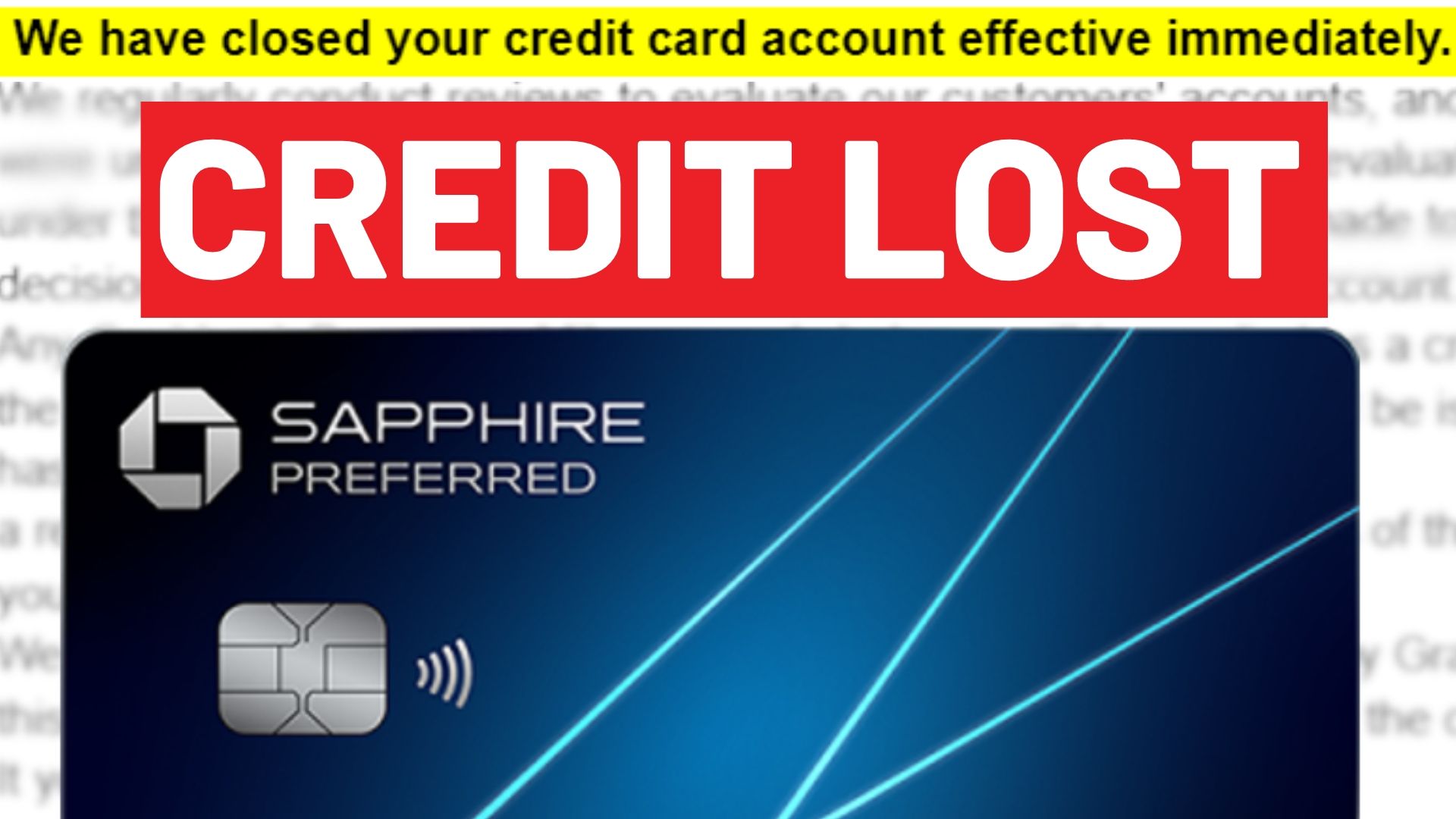
Chase can close credit card accounts permanently without much warning.
And when it happens, it can feel brutal.
Imagine saving thousands of Chase Ultimate Rewards points for a trip, then one day your Sapphire Preferred gets declined.
You call Chase.
They tell you your cards have been canceled.
They will not give you much detail over the phone.
They say a letter is coming.
And now you are scrambling to figure out what happens to your points, your available credit, and your entire Chase setup.
That is the part people do not always understand.
Getting approved by Chase is not the finish line.
Chase may continue monitoring your credit profile and account behavior after approval.
And if their system decides your relationship is too risky, they can take action.
Disclosure: This article may contain affiliate links, which means I may earn compensation if you click or apply through certain links.
Quick Answer
Chase may close credit card accounts for several reasons, including missed payments, returned payments, too many new accounts, too many recent inquiries, credit cycling, cash-like transactions, excessive disputes, inactivity, business activity in personal accounts, or behavior that looks risky after a periodic review. Not every closure is predictable, but most shutdown data points have one thing in common: Chase saw something that made the account look riskier than it did when it was first approved.
Chase Can Keep Watching You After Approval
A lot of people think once Chase approves them, they are safe.
That is not always true.
Banks can continue monitoring your credit report after approval.
That means Chase may see:
-
New hard inquiries
-
New credit cards
-
Higher balances
-
Missed payments with other banks
-
Charge-offs or collections
-
Sudden changes in credit behavior
This is why some people get approved, use the card normally for months, and then suddenly receive an account closure.
It may feel random.
But from the bank’s side, it usually comes from some type of risk review.
That review may involve your Chase account behavior, your outside credit behavior, or both.
Reason #1: Missed Payments
The biggest and most obvious reason Chase may close accounts is missed payments.
If you stop paying Chase, they have every reason to reduce their risk.
And the shutdown may not be limited to the one card you missed payments on.
Chase can look at the entire relationship.
That means if you miss payments on one Chase card, other Chase cards may also be closed.
This can happen even if the other cards had no balance and were always paid correctly.
From Chase’s perspective, the risk is not only one card.
The risk is you as a customer.
That is why missed payments are the most dangerous shutdown trigger.
How to Avoid This
Set up autopay.
But do not blindly trust autopay.
Check that the payment actually posts.
Also set a calendar reminder a few days before the due date.
That way, if autopay fails or the wrong account is linked, you have time to fix it before the payment becomes late.
The goal is simple:
Never let a Chase payment be missed.
Reason #2: Returned Payments
A returned payment can be almost as dangerous as a missed payment.
A returned payment happens when you try to pay your credit card, but the payment does not go through.
That can happen because of:
-
Insufficient funds
-
Wrong bank account information
-
A closed account
-
A debit card limit
-
A failed transfer
-
A bank processing issue
The problem is that Chase may not care whether it was an innocent mistake.
From their perspective, a returned payment can signal financial instability or fraud risk.
And if it happens on a Chase account, they may act quickly.
Why Returned Payments Are So Serious
Returned payments tell a bank one thing:
The money was supposed to be there, but it was not.
That makes banks nervous.
Even if you fix it later, the damage may already be done.
That is why I do not like paying credit card bills with debit cards or unstable payment methods.
A clean ACH payment from a reliable checking account is usually better.
Before paying Chase, make sure the money is already sitting in the account and available.
Do not pay first and hope the transfer clears in time.
Reason #3: Too Many New Accounts
Chase is already famous for the 5/24 rule.
But even if you get past 5/24, opening too many accounts too fast can still create problems.
One shutdown data point involved someone who opened a Chase Sapphire Preferred, closed it quickly, then applied for other Chase cards shortly after.
That kind of behavior can look suspicious.
From Chase’s perspective, it may look like:
-
Bonus chasing
-
Gaming the system
-
Financial instability
-
Risky account behavior
-
Too much new credit too quickly
Banks do not like chaos.
Opening cards, closing cards, and reapplying within days can make you look like a risky customer.
Slow Down With Chase Applications
Do not treat Chase like a game where you grab every bonus as fast as possible.
If you want a long-term Chase relationship, slow down.
Space out applications.
Keep accounts open.
Use them normally.
Avoid opening and closing cards quickly unless you have a very good reason.
With Chase, looking stable matters.
Reason #4: Too Many Recent Inquiries
Too many hard inquiries can also trigger concern.
One data point involved a Chase customer whose cards were closed after a periodic review.
The reason they were given was too many recent inquiries and too much credit obtained over the past year.
That is what banks often call credit-seeking behavior.
Even if some inquiries came from auto loans or leases, the bank may still see a crowded report.
And Chase may decide it no longer wants the exposure.
This is why hard inquiries matter even after approval.
The bank may not stop looking at your report just because the card is already open.
Helpful resource: If you want to avoid unnecessary hard pulls, my Free Credit Card & Loan Pre-Approval Master List can help you find cards and lenders that may let you check your odds before applying: https://courses.calbartoncashback.com/pre-approval-master-list-Blog
Reason #5: Credit Cycling
Credit cycling is when you repeatedly use your credit limit, pay it off, and use it again inside the same billing cycle.
For example, if you have a $15,000 limit and run $80,000 through the card in two months, that may look risky.
Even if you are paying it off.
Even if your business revenue supports it.
Even if the spending is legitimate.
Banks may still see the pattern and ask:
Why is this person running far more spend than the approved limit?
That can trigger fraud reviews, account locks, or closures.
Why Credit Cycling Spooks Banks
Credit cycling can make a bank think you are trying to push more money through the account than they intended to approve.
It may look like:
-
Manufactured spending
-
Money movement risk
-
Fraud risk
-
Business activity the card was not sized for
-
Unusual transaction behavior
If your business truly spends at a high level, you may need a card designed for that kind of volume.
A traditional credit card with a smaller limit may not be the best fit.
Helpful resource: If your business spending is too high for a traditional Chase limit, Divvy may be worth researching because it is designed for business spending and may scale based on business activity: https://offers.calbartoncashback.com/Divvy
Reason #6: Cash-Like Transactions
Cash-like transactions are another major warning sign.
These can include things like:
-
Gift cards
-
Money orders
-
Cash-equivalent purchases
-
Some payment app activity
-
Certain PayPal, Venmo, or money movement transactions
The problem is that these transactions can look like someone is trying to turn credit into cash.
Banks hate that.
It can raise fraud, abuse, or money-laundering concerns.
One data point involved someone buying a lot of Visa and Mastercard gift cards and later dealing with a Chase shutdown.
That is not surprising.
Chase may tolerate normal spending.
But if the account starts looking like a cash-generation machine, the relationship can get risky fast.
Reason #7: Too Many Disputes or Chargebacks
Disputes and chargebacks exist for a reason.
If a merchant refuses to fix a legitimate problem, your bank may need to step in.
But too many disputes can make your account look risky.
Even if the disputes are legitimate, Chase’s system may start seeing a pattern.
That pattern could look like abuse.
It could look like customer risk.
It could look like someone who creates too much operational cost.
That does not mean you should never dispute anything.
If you are genuinely wronged, protect yourself.
But do not use disputes casually.
Try to resolve issues with the merchant first.
Keep documentation.
And only involve the bank when it is actually necessary.
Reason #8: Credit Limits Too High Compared to Your Profile
This one surprises people.
Your credit limits can sometimes become too high from the bank’s perspective.
One data point involved someone who opened two Chase cards in a short period, with limits around $19,000 and $20,000.
Later, Chase reportedly closed the accounts because the credit limits were too high relative to the person’s credit history.
That sounds unfair.
After all, Chase approved the limits.
But banks manage exposure.
Exposure means how much money they are willing to risk on one customer.
If your total Chase limits grow too quickly compared to your income, history, or overall profile, Chase may decide it is overexposed.
That can lead to closures or limit reductions.
Watch Your Total Chase Exposure
Do not assume every high limit is automatically safe.
A high limit is great when your profile supports it.
But if you open multiple cards quickly and Chase gives you a lot of credit all at once, that can create risk.
Some people prefer keeping Chase limits below a certain percentage of income.
There is no perfect public formula.
But the larger your Chase exposure gets, the more careful you should be with applications, spending, payments, and new credit behavior.
Reason #9: Business Deposits in Personal Accounts
If you run a business, do not treat your personal checking account like a business account.
One shutdown data point involved a contractor receiving multiple business deposits into a personal Chase account.
Chase reportedly did not like that and closed the checking, savings, and credit card relationship.
That makes sense from a bank risk standpoint.
Business activity has different monitoring needs.
Personal accounts are not designed for constant business deposits from multiple sources.
If you mix business and personal money, it can raise compliance concerns.
Keep Business Banking Separate
If you are operating a business, open a business checking account.
Use it for:
-
Client payments
-
Contractor payments
-
Business deposits
-
Business expenses
-
Payment processor payouts
-
Business transfers
Do not run business income through your personal account just because it feels easier.
The shortcut can create a much bigger problem later.
Reason #10: Too Many Authorized Users
Authorized users can be useful.
They can help a spouse, child, or close family member build credit.
But adding too many authorized users can create risk.
Especially if the users are not close family.
Especially if they are in different countries.
Especially if the pattern looks like you are selling authorized-user tradelines.
Banks do not like that.
One data point involved a customer who added authorized users after applying for a Chase Sapphire card and later had old and new accounts closed.
That is a serious warning.
Use authorized users responsibly.
Do not turn your Chase cards into a tradeline business.
Reason #11: Large Transactions on Brand-New Cards
Large transactions on brand-new cards can trigger reviews.
Especially if the card has no spending history yet.
If you open a new Chase card and immediately run a huge PayPal transaction or max out the limit, that may look suspicious.
From your perspective, you may be trying to hit a welcome bonus.
From Chase’s perspective, the account has no history and suddenly shows high-risk activity.
That can lead to a lock, review, or closure.
A new card needs a normal usage pattern.
Do not make the first transaction look like a stress test.
Reason #12: Inactivity
Sometimes Chase closes cards for the opposite reason.
No usage.
If a card sits unused for too long, Chase may close it for inactivity.
That is common across many banks.
An unused credit line costs the bank money, creates risk, and does not generate much value.
If you want to keep a card open, use it occasionally.
A small recurring charge can help.
Think streaming service, gas, or a small subscription.
Then pay it off automatically.
Do not let valuable Chase cards sit untouched forever.
What Happens to Chase Ultimate Rewards Points After Closure?
This is one of the scariest parts.
If Chase closes your account, you may have limited time to use or transfer your points.
The exact options can depend on the card, closure reason, and account status.
But the lesson is simple:
Do not hoard points forever without a plan.
Points are not cash in a bank account.
They are controlled by the rewards program.
If your account is closed, restricted, or frozen, your points can become harder to access.
If you have a large Ultimate Rewards balance, make sure you understand your redemption options before there is a problem.
How to Reduce the Risk of a Chase Shutdown
You cannot control everything Chase does.
But you can reduce risk.
Here is the basic checklist:
-
Pay every Chase card on time
-
Avoid returned payments
-
Do not credit cycle aggressively
-
Avoid cash-like transactions
-
Do not overload Chase with applications
-
Keep recent inquiries low
-
Do not open and close Chase cards quickly
-
Use business accounts for business deposits
-
Keep authorized users limited and legitimate
-
Avoid maxing out brand-new cards immediately
-
Use inactive cards occasionally
-
Keep another bank relationship as backup
That last point matters.
Never rely on one bank for everything.
If Chase shuts you down, you do not want to lose access to all your credit and banking at once.
What to Do If Chase Closes Your Account
If Chase closes your account, stay calm and get organized.
First, ask for the reason.
They may not give full details over the phone, but ask anyway.
Second, wait for the written letter.
That letter may explain the reason more clearly.
Third, check your credit reports.
Look for anything new that may have triggered the review.
Fourth, redeem or transfer points quickly if Chase allows it.
Fifth, if fraud or incorrect credit reporting caused the shutdown, gather documentation.
That may include police reports, CFPB complaints, FTC reports, dispute results, or creditor letters.
Sixth, consider visiting a Chase branch if you need documents uploaded to your file.
Reinstatement is not guaranteed.
But if the closure was based on incorrect information, documentation matters.
Frequently Asked Questions
Can Chase close your credit card without warning?
Yes. Banks can close or restrict credit card accounts if they believe the account creates risk, violates policy, or no longer fits their underwriting standards.
Why did Chase close all my cards?
Chase may close multiple cards at once if the risk is tied to the overall customer relationship. Common triggers include missed payments, returned payments, credit-seeking behavior, high exposure, fraud concerns, or policy violations.
Can too many inquiries cause Chase to close accounts?
Yes, too many recent inquiries or too much new credit can be viewed as credit-seeking behavior. Chase may take action after a periodic review if the profile looks riskier than before.
What is credit cycling?
Credit cycling is when you repeatedly use your credit limit, pay it down, and use it again within the same billing cycle. Banks may view this as risky because you are running more volume through the account than the approved limit suggests.
Can returned payments get a Chase account closed?
Yes. Returned payments can be a major warning sign because they suggest payment failure, account issues, or financial instability. Even accidental returned payments can create problems.
How do I avoid Chase closing my card for inactivity?
Use the card occasionally. A small recurring purchase every few months can help keep the account active, but make sure the bill is paid on time.
Final Thoughts
Chase shutdowns can feel sudden.
But most shutdown stories have warning signs.
Missed payments.
Returned payments.
Too many new accounts.
Too many inquiries.
Credit cycling.
Cash-like transactions.
Too many disputes.
Business deposits in personal accounts.
Too many authorized users.
Large transactions on brand-new cards.
Inactivity.
The key is not to be afraid of Chase.
The key is to understand what Chase tends to dislike.
If you want a long-term Chase relationship, act like a low-risk customer.
Pay on time.
Keep payments clean.
Avoid weird transaction patterns.
Do not open and close cards like a game.
Do not run business activity through personal accounts.
And do not rely on Chase as your only source of credit.
Chase has some of the best credit cards in the market.
But the relationship needs to be managed carefully.
Because getting approved is one thing.
Keeping the account open is the real game.