
TransUnion Credit Cards: How to Stack Approvals More Strategically
Jun 27, 2026
There are over 100 credit cards that may primarily pull TransUnion based on data points.
And if you understand how to use that information, you can apply for credit cards with more strategy instead of guessing.
Most people apply like this:
Find a card.
Click apply.
Hope it works.
Then repeat the same mistake again.
No plan.
No bureau strategy.
No understanding of which credit report the bank is likely to pull.
That is how hard inquiries end up scattered across Experian, Equifax, and TransUnion.
But if you know which banks tend to pull TransUnion, you may be able to build a cleaner application strategy.
Not guaranteed.
Not perfect.
But much smarter than applying blind.
Disclosure: This article may contain affiliate links, which means I may earn compensation if you click or apply through certain links.
Quick Answer
Some credit card issuers often pull TransUnion based on reported data points, including U.S. Bank, Synchrony, Navy Federal, Barclays, BMO, and certain Imprint-powered cards. Bureau pulls are never guaranteed, but understanding which banks commonly use TransUnion can help you apply more strategically, protect cleaner bureaus, and avoid spreading inquiries across all three credit reports.
Most People Are Applying Blind
Most people do not think about credit bureau strategy.
They only think about the card.
They ask:
“Do I want this card?”
But they do not ask:
“Which bureau does this bank usually pull?”
That is a mistake.
Every time you apply for a credit card, the bank may pull one of your three credit reports:
-
Experian
-
Equifax
-
TransUnion
And once that hard inquiry lands, other lenders can see it.
If you apply randomly across different banks, you may end up with hard inquiries spread across all three bureaus.
That can make your whole credit profile look more active.
But if you know which banks tend to pull which bureau, you can be more strategic.
Why TransUnion Is an Opportunity
TransUnion is interesting because several major and mid-tier issuers often show up in TransUnion-pull data points.
That does not mean they pull TransUnion every single time.
Bureau pulls can vary by state, product, applicant profile, frozen reports, issuer policy, and internal underwriting.
But the patterns are consistent enough to pay attention to.
Based on my tracking, there are 100+ credit cards across a handful of issuers that may lean toward TransUnion.
That gives you room to build a strategy around one bureau instead of applying randomly.
The Core TransUnion Issuers
The main issuers behind this strategy include:
-
U.S. Bank
-
BMO
-
Imprint-powered cards
-
Synchrony
-
Navy Federal
-
Barclays
Across those issuers, you can find more than 100 credit card options.
That includes cash back cards, travel cards, store cards, secured cards, credit union cards, airline cards, retail cards, and co-branded cards.
The point is not to apply for everything.
The point is to understand the map.
When you know where the TransUnion-heavy opportunities are, you can build a cleaner plan.
The Bureau Freeze Strategy
One strategy some people use is freezing Experian and Equifax before applying.
The idea is simple:
If the lender supports TransUnion and cannot access Experian or Equifax, the application may route to TransUnion.
But this is not guaranteed.
A lender may:
-
Pull TransUnion
-
Ask you to unfreeze another bureau
-
Deny the application
-
Delay the application
-
Cancel the application
-
Use a bureau you did not expect
So do not treat this like a magic trick.
Freezing credit reports is a legitimate consumer protection tool.
But using freezes as part of an application strategy comes with risk.
The safe way to say it is this:
Freezing other bureaus may help influence which bureau gets pulled with some lenders, but it does not force every bank to use TransUnion.
Why This Strategy Matters
If the strategy works, you may be able to keep two bureaus cleaner while one bureau takes the inquiry.
That can help because different banks care about different bureaus.
For example, maybe you want to keep Experian clean for Amex or Chase.
Maybe you want Equifax clean for certain credit unions.
Maybe TransUnion is already your strongest bureau.
Maybe you are building a TransUnion-focused application sequence.
The goal is not to hide risk.
The goal is to apply with more structure.
A smart credit strategy is about knowing what the bank is likely to see before you hit submit.
Helpful resource: If you want to avoid applying blindly, my Free Credit Card & Loan Pre-Approval Master List can help you find banks and cards that may let you check your odds with a soft pull before applying: https://courses.calbartoncashback.com/pre-approval-master-list-Blog
U.S. Bank TransUnion Cards
U.S. Bank is one of the issuers that often shows up in TransUnion-pull data points.
They have a strong credit card lineup, including:
-
Cash back cards
-
Travel cards
-
Secured cards
-
0% APR cards
-
Business credit cards
-
Co-branded cards
U.S. Bank can be conservative.
So I would not treat them like an easy approval bank.
They may care about recent accounts, recent inquiries, banking relationships, utilization, and overall profile strength.
But if your profile is clean, U.S. Bank can be worth researching.
They also have some strong 0% APR products, which can make them useful for people trying to manage large purchases or business expenses without paying interest immediately.
Synchrony TransUnion Cards
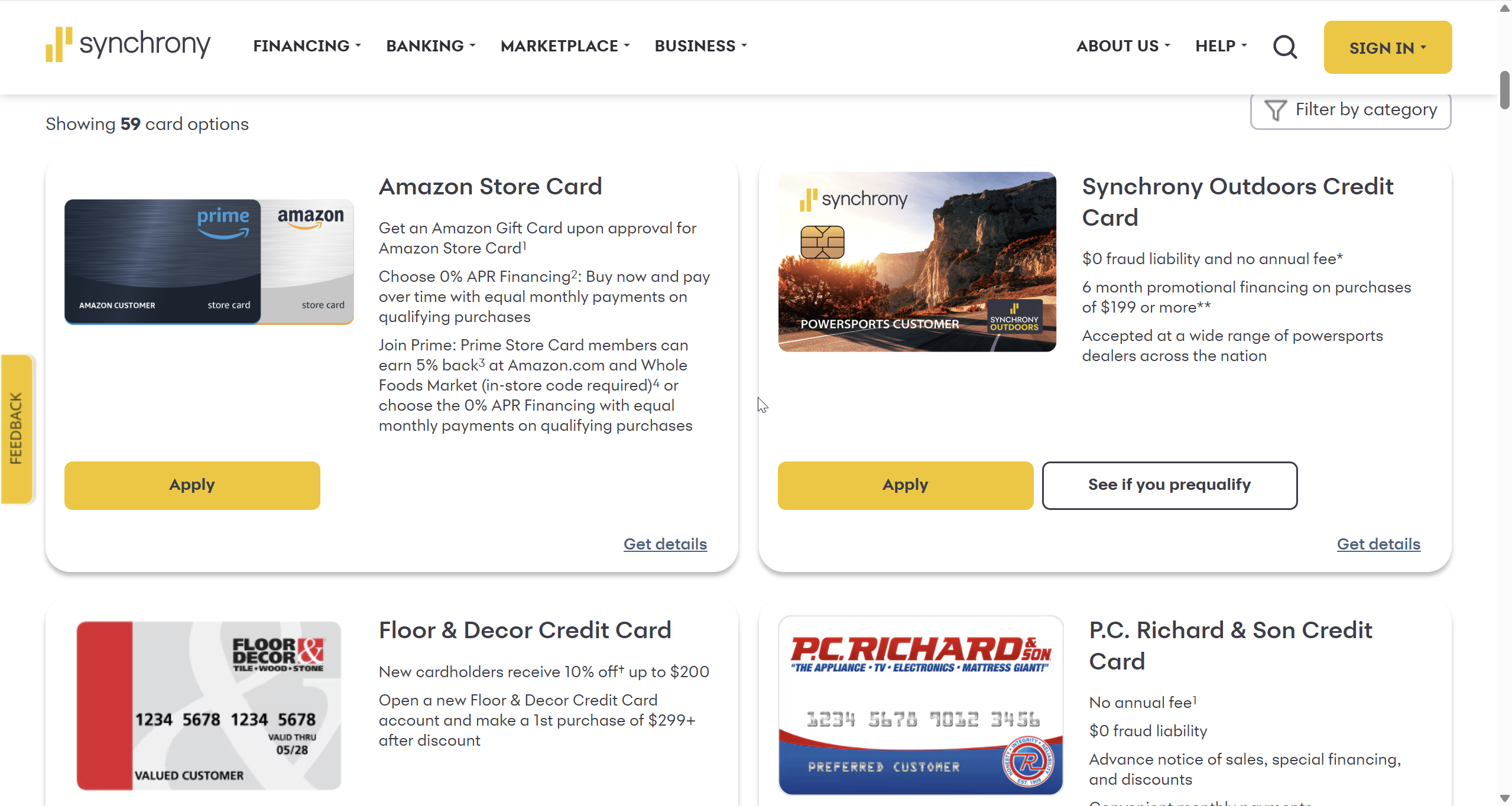
Synchrony is another major part of this strategy.
Synchrony powers a large number of store, retail, and co-branded credit cards.
That includes cards tied to brands like:
-
Amazon
-
PayPal
-
Venmo
-
Verizon
-
Lowe’s
-
Retail stores
-
Financing partners
One reason Synchrony matters is that many Synchrony cards offer prequalification or preapproval paths.
That means you may be able to check whether you are likely to qualify before taking a hard inquiry.
That is a big deal if you are stacking cards strategically.
Synchrony can also be useful because some people are able to hold multiple Synchrony-backed cards and grow limits over time.
I have personally stacked $20,000 limits on multiple Synchrony cards.
That does not mean everyone will get the same result.
But Synchrony is definitely one of the issuers worth understanding if you are building a TransUnion-focused strategy.
Navy Federal TransUnion Cards
Navy Federal is known for one thing in the credit card world:
High limits.
People call Navy Federal the “House of High Limits” for a reason.
You will see data points of people getting $20,000, $25,000, $30,000, and sometimes much higher limits.
And Navy Federal often shows up in TransUnion-pull data points.
Recently, Navy Federal approved me for a $25,000 More Rewards card after about six weeks of membership.
That approval is one of the reasons I take Navy Federal seriously.
But Navy Federal is not open to everyone.
You need a legitimate membership path.
That can include military service, eligible family relationships, or eligible household relationships.
Do not lie to get in.
If you are eligible, Navy Federal can be powerful.
If you are not eligible, there are other credit unions to study.
Barclays TransUnion Cards
Barclays is another issuer that can fit into a TransUnion strategy.
Barclays has offered cards tied to:
-
Airlines
-
Travel brands
-
Retail partners
-
Entertainment brands
-
Co-branded programs
Barclays can be more selective than some other issuers.
They may care about recent accounts, recent inquiries, existing Barclays exposure, and overall credit profile.
But when Barclays approvals hit, the limits can be solid.
I would not put Barclays in the easy-approval category.
I would put them higher on the ladder.
That means you probably want a cleaner profile before applying.
BMO TransUnion Cards
BMO can also appear in TransUnion-focused strategies.
They have personal and business credit card options, including cash back and rewards products.
BMO is not always talked about as much as Chase, Amex, or Capital One.
But that is exactly why it can be worth studying.
Sometimes the best opportunities are not the loudest ones.
If you are building a bureau-specific strategy, smaller or less-hyped issuers can matter.
The key is making sure the card actually fits your profile and goals.
Do not apply just because a bank may pull TransUnion.
Apply because the card makes sense and the bureau strategy supports the move.
Imprint-Powered Cards
Imprint-powered cards are one of the more interesting parts of this strategy.
Imprint works behind the scenes on co-branded card programs.
Some Imprint-powered cards may show your approval and credit limit before you fully accept the card.
That changes the application experience.
Instead of applying blind and waiting to see what happens, you may see the actual offer first.
In some cases, people have also reported getting approved without a hard pull by using a bureau-freeze strategy before accepting the offer.
I have personally done this with two Imprint-powered cards this year without a hard pull appearing.
But this is important:
That is a data point, not a guarantee.
The Three-Step Imprint Play
The three-step play looks like this:
Step 1: Unfreeze TransUnion only.
Step 2: Apply and view the approval and limit.
Step 3: Refreeze TransUnion before accepting the offer.
In my experience, this allowed me to accept the offer without a hard pull appearing.
But again, this may not work for everyone.
The issuer could change the process.
The card could require a hard pull.
They could ask you to unfreeze your report again.
The application could be delayed.
The approval could be canceled.
So treat this as an advanced strategy with risk, not a universal rule.
What This Can Turn Into
If you build across TransUnion-heavy issuers carefully, the total credit access can become meaningful over time.
For example, across different issuers, someone could eventually build:
-
Navy Federal limits
-
Synchrony limits
-
U.S. Bank limits
-
Barclays limits
-
Imprint card limits
-
BMO limits
This could turn into $50,000, $100,000, or even $200,000+ in total available credit for the right profile.
Not overnight.
Not guaranteed.
And not without risk.
But very possible if you have good credit, low utilization, responsible payment history, and a smart application sequence.
Do Not Stack Cards Without a Plan
This is where people mess up.
They hear “100+ TransUnion cards” and think the move is to apply for everything.
That is not the move.
The move is to apply strategically.
Before applying, ask:
-
Does this card fit my actual spending?
-
Does this issuer usually pull TransUnion?
-
Is my TransUnion report clean?
-
Are my other bureaus frozen?
-
Do I have recent inquiries?
-
Do I have recent new accounts?
-
Is my utilization low?
-
Can I meet the welcome offer naturally?
-
Will this card help my long-term credit profile?
If the answer is no, slow down.
A bureau strategy does not fix a bad application strategy.
Why Soft-Pull Preapproval Still Matters
Even if you know an issuer often pulls TransUnion, preapproval is still valuable.
A soft-pull preapproval can help you see your odds before a hard inquiry.
That matters because a hard pull with a denial is the worst outcome.
You lose the inquiry and get no account.
Preapproval does not guarantee approval.
But it gives you more information.
That is why I like building around cards and banks that let you check first.
The more information you have before applying, the less you have to guess.
How to Use TransUnion Strategy the Right Way
A cleaner TransUnion strategy would look like this:
First, check all three credit reports.
Second, identify which bureau is cleanest.
Third, decide which bureaus you want to protect.
Fourth, research which issuers are likely to pull TransUnion.
Fifth, freeze the bureaus you do not want pulled if that fits the strategy.
Sixth, use preapproval tools where available.
Seventh, apply slowly.
Eighth, track every inquiry and approval.
Ninth, stop before your profile looks too aggressive.
That last point matters.
Credit stacking works best when you know when to pause.
The Biggest Risks
This strategy has real risks.
The biggest ones are:
-
Bureau pulls can vary
-
Freezing reports can cause denials
-
Too many applications can trigger shutdowns
-
Too many new accounts can hurt approvals
-
TransUnion can become overloaded with inquiries
-
Some banks may pull multiple bureaus
-
Some preapprovals may still lead to denials
-
Some offers may change after acceptance
That is why I would never call this guaranteed.
It is a strategy.
Not a promise.
Frequently Asked Questions
Which credit cards pull TransUnion?
Based on data points, issuers like U.S. Bank, Synchrony, Navy Federal, Barclays, BMO, and some Imprint-powered cards often show up as TransUnion pullers. But bureau pulls can vary by applicant, state, product, and issuer policy.
Can you force a bank to pull TransUnion?
Not always. Freezing Experian and Equifax may influence the pull with some lenders, but a bank can still ask you to unfreeze another bureau, delay the application, deny the application, or use a different process.
Does Synchrony pull TransUnion?
Synchrony frequently appears in TransUnion-pull data points, and many Synchrony cards offer prequalification paths. Still, you should check current data points before applying.
Does Navy Federal pull TransUnion?
Navy Federal often appears in TransUnion-pull data points, and my $25,000 More Rewards approval pulled TransUnion. But bureau pulls can vary, so do not assume every Navy Federal application will pull the same bureau.
Can Imprint cards approve without a hard pull?
Some people, including me, have reported Imprint-powered card approvals without a hard pull by using a bureau-freeze strategy. This is not guaranteed and could change at any time.
Is applying for 100 TransUnion cards a good idea?
No. The point is not to apply for everything. The point is to know which cards may pull TransUnion so you can apply more strategically and avoid wasting hard inquiries.
Final Thoughts
A TransUnion credit card strategy can be powerful.
Not because it guarantees approvals.
And not because it magically protects your credit.
It works because it gives you structure.
Instead of applying randomly and letting hard inquiries hit all three bureaus, you start paying attention to where each issuer is likely to pull.
That gives you more control.
U.S. Bank.
Synchrony.
Navy Federal.
Barclays.
BMO.
Imprint-powered cards.
Together, these issuers create a large pool of possible TransUnion-focused opportunities.
But the strategy only works if you stay disciplined.
Use preapprovals when possible.
Freeze bureaus carefully.
Apply slowly.
Track your data points.
Keep utilization low.
And do not chase cards just because they may pull TransUnion.
The real goal is not to collect inquiries.
The goal is to build a stronger credit profile with fewer wasted moves.