
How One Navy Federal Member Built $50,000 in Credit Limits in 7.5 Months
Jun 29, 2026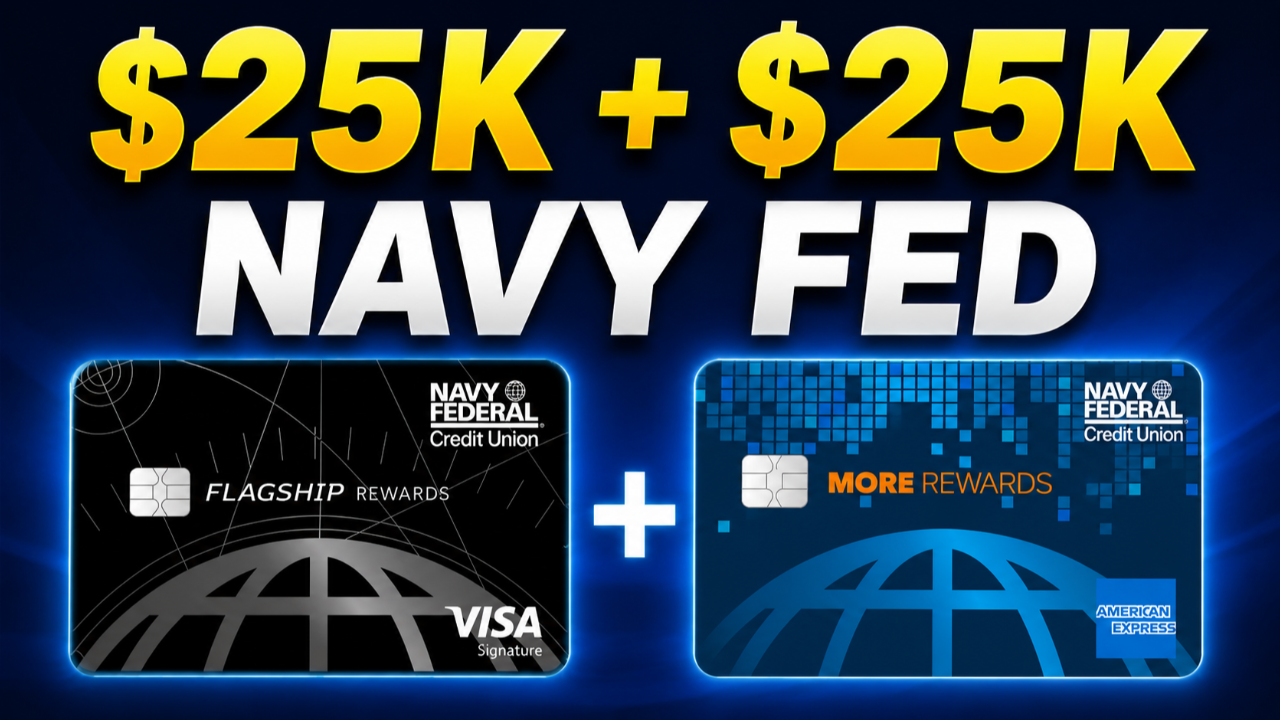
One Navy Federal member built $50,000 in credit card limits in just 7 and a half months.
And no, this was not random.
They did not just join Navy Federal, throw in a tiny deposit, apply immediately, and hope for the best.
They built the relationship from day one.
Checking.
Savings.
Direct deposits.
Bill pay.
A checking line of credit.
A pledge loan.
A certificate.
Then two major credit card approvals.
That is why this data point matters.
It shows how powerful Navy Federal can be when you treat the relationship like a strategy instead of a quick application.
Quick Answer
A Navy Federal member reportedly reached $50,000 in total credit card limits in about 7.5 months by opening checking and savings, using direct deposit-style activity, adding a checking line of credit, opening and mostly paying down a pledge loan, using bill pay, opening a certificate, and then applying for Navy Federal credit cards after the relationship was built. They were approved for a $25,000 More Rewards card and later a $25,000 Flagship card. Your results can vary based on income, credit profile, Navy Federal relationship, debt-to-income, product, timing, and underwriting.
Disclosure: This article may contain affiliate links, which means I may earn compensation if you click or apply through certain links.
Helpful resource: Before applying for any new card, my Free Credit Card & Loan Pre-Approval Master List can help you check soft-pull pre-approval tools so you are not blindly risking hard pulls.
Why Navy Federal Is Known for High Limits
Navy Federal has a reputation in the credit community as the house of high limits.
That does not mean everyone gets approved.
And it definitely does not mean everyone gets $25,000 right away.
But Navy Federal is one of those credit unions where relationship-building can matter.
The member in this data point did not just apply cold.
They created multiple touchpoints with Navy Federal before going after the big cards.
That is the lesson.
A high credit limit is not just about having a good score.
It is also about looking like a strong, active, low-risk member.
The Setup: This Was Not Just a Credit Card Play
The original data point was not only about credit cards.
It was a full relationship-building strategy.
The member used:
-
Everyday checking
-
Savings
-
Regular transfers
-
Checking line of credit
-
Pledge loan
-
Bill pay
-
Flagship checking
-
Direct deposit
-
A second checking account
-
A certificate of deposit
-
Then credit card applications
That is a lot of activity in a short period of time.
And from Navy Federal’s perspective, that activity may have helped the member look more established.
Banks and credit unions like active relationships.
They want deposits.
They want payments.
They want transaction activity.
They want evidence that you are actually using them.
This person gave Navy Federal all of that before asking for serious credit.
March 7, 2022: Joined Navy Federal and Funded the Accounts
On March 7, 2022, the member joined Navy Federal and opened an Everyday Checking account and a savings account.
They deposited $250 total:
-
$100 into checking
-
$150 into savings
That is not a huge deposit.
But it started the relationship.
The original data point also mentioned funding the opening deposit with a credit card.
That can be useful if allowed, but this is something you need to verify before trying it.
Banks and credit unions can change funding rules.
Some may treat credit card funding as a purchase.
Others may treat it as a cash advance.
That distinction matters.
A cash advance can trigger fees and interest immediately.
So do not copy that part blindly.
Direct Deposit-Style Activity
The member also set up biweekly transfers of around $500 using Astra to mimic direct deposits.
Astra is no longer the same clean option it was at the time, so I would not build a current strategy around that exact tool.
But the concept still matters.
Navy Federal, like many financial institutions, may value active deposits.
That could mean:
-
Real payroll direct deposit
-
Transfers from another bank
-
Business account transfers
-
Brokerage transfers
-
Regular ACH activity
The point is not to fake income.
The point is to make the account look alive.
A dead checking account does not build much of a relationship.
An active account with consistent deposits tells a different story.
April 26, 2022: Approved for a Checking Line of Credit
On April 26, 2022, the member applied for a checking line of credit attached to the Everyday Checking account.
They were approved for $500.
The data point says this triggered a TransUnion hard pull.
A checking line of credit can help cover overdrafts or denied transactions if your checking balance is short.
Navy Federal publicly describes its checking line of credit as a credit product that is subject to approval. Navy Federal also says checking line of credit limits are generally $500, with higher limits possible depending on factors like length of membership, direct deposit, active duty status, and creditworthiness.
So this $500 approval lines up with Navy Federal’s own general guidance.
Now, is a $500 checking line of credit exciting?
Not by itself.
But as a relationship-building signal, it matters.
It adds another credit product.
It adds another approval.
It adds more internal history.
That can help when you are trying to build toward larger approvals later.
April 28, 2022: Opened a $2,400 Pledge Loan
Two days later, on April 28, 2022, the member deposited $2,400 to use for a Navy Federal pledge loan.
A pledge loan is a secured loan.
You borrow against money you already have on deposit.
That means the lender has less risk because your own funds are securing the loan.
People use pledge loans for two main reasons:
-
Credit building
-
Relationship building with the credit union
In this data point, the pledge loan term was 36 months at 2.25% APR.
That rate was specific to the time and product, so do not assume it is available today.
The bigger point is that the pledge loan gave the member another active Navy Federal product reporting positively.
Why a Pledge Loan Can Help
A pledge loan can help your profile in a few ways.
It can add installment loan history.
It can create positive payment history.
It can show the credit union you are using more than just a checking account.
It can also help if your credit profile is thin or missing an installment account.
Payment history is the biggest FICO scoring category, and installment account mix can also matter.
But be careful.
A pledge loan is not magic.
It does not guarantee a 38-point score jump for everyone.
Your score impact depends on your existing profile.
If you already have several installment loans, the effect may be smaller.
If you have a thin file, the effect may be bigger.
April 29, 2022: Bill Pay and Early Pledge Loan Paydown
The next day, on April 29, 2022, the member started paying bills through their Everyday Checking account.
That matters.
Bill pay sends the credit union another signal:
“This is becoming my real banking relationship.”
Then they did something even more interesting.
They paid off about 93% of the pledge loan almost immediately.
The original loan was $2,400.
They paid roughly $2,200, leaving about $168 remaining.
That left a tiny monthly payment of around $4 for the rest of the term.
This is a common Navy Federal pledge loan strategy.
The idea is to create the loan, pay most of it down, get most of your secured funds released back, and still keep the loan reporting as paid as agreed.
Why Paying Down the Pledge Loan Early Can Work
The logic is simple.
You do not want your money locked up forever.
So if the credit union releases the paid-down portion of the secured funds, you regain access to most of your cash.
Meanwhile, the loan can continue reporting.
That gives you the relationship and credit-building benefit without tying up all the money for the full term.
But this is another area you need to verify before copying.
Rules, reporting, fund-release timing, and loan structures can change.
Also, do not pay the loan completely off if your goal is to keep it reporting over time.
Paying almost all of it down is different from paying it off entirely.
May 3, 2022: Funds Became Available Again
Shortly after the large pledge loan payment, the repaid funds reportedly became available again.
In this data point, it took about 4 days.
That is useful because it means the member was not stuck without access to most of the $2,400 for the full 36 months.
This is one reason people like pledge loans.
They can use existing savings to build credit and relationship history while still regaining access to much of the money after paying the loan down.
But again, treat the 4-day release as a data point.
Not a guarantee.
May 10, 2022: Upgraded to Flagship Checking
On May 10, 2022, the member converted the Everyday Checking account into a Flagship Checking account.
Flagship Checking can offer extra benefits, but it also has balance requirements if you want to avoid fees.
The member then started direct depositing their actual paycheck into the account.
That is important.
Real payroll direct deposit is stronger than random transfers.
It tells the credit union:
“This is my main banking relationship.”
The member also opened a second Everyday Checking account for non-Navy Federal bills.
At this point, they had multiple accounts and real activity flowing through Navy Federal.
That is relationship-building.
Not theory.
Actual usage.
May 20, 2022: Opened a 12-Month Certificate
On May 20, 2022, the member opened a 12-month certificate of deposit.
A certificate is a savings product where you lock money for a set period in exchange for a stated return.
At the time, the certificate reportedly had a 2.9% APR/APY-style rate and a $30 bonus offer if the member initiated three recurring transfers within 60 days.
Bonus offers matter.
They show what products the institution is trying to promote.
If a bank or credit union is giving bonuses for a product, that product may be strategically important to them.
That does not mean you should open every bonus product.
But if the product fits your plan, it can be another relationship-building touchpoint.
May 30, 2022: Pledge Loan Reported and FICO Jumped
On May 30, 2022, just over 30 days after opening the pledge loan, it reportedly showed up on the member’s credit reports.
Then the big score jump happened.
Their FICO score reportedly increased by 38 points across each credit bureau, bringing their average score to around 750.
That is a huge move.
But let’s be careful here.
That does not mean every pledge loan gives everyone 38 points.
Score impact depends on what is already in your profile.
If your file was thin, missing installment history, or had limited positive activity, a new secured installment loan could help more.
If your file is already thick and optimized, the impact could be small or even not noticeable.
Still, for this member, the timing was powerful.
The score jump happened before the big credit card applications.
That may have helped.
June 7, 2022: Preselected for the More Rewards Card
On June 7, 2022, the member received a preselected email offer for the Navy Federal More Rewards American Express Card.
A few days later, they received the same offer in the mail.
That matters because preselected offers can be a sign the credit union is comfortable enough to market credit to you.
It is not a guarantee.
But it is a signal.
Navy Federal currently says members can prequalify before applying for a credit card, and the prequalification uses information without affecting your credit score. Navy Federal also says prequalification does not guarantee approval when you apply.
That last part is important.
Preselected and prequalified are helpful signals.
They are not final approvals.
June 24, 2022: Approved for $25,000 More Rewards
On June 24, 2022, the member accepted the More Rewards offer.
They were approved for a $25,000 starting limit.
The APR was reportedly 13.2%, with a 0.99% intro rate for the first year.
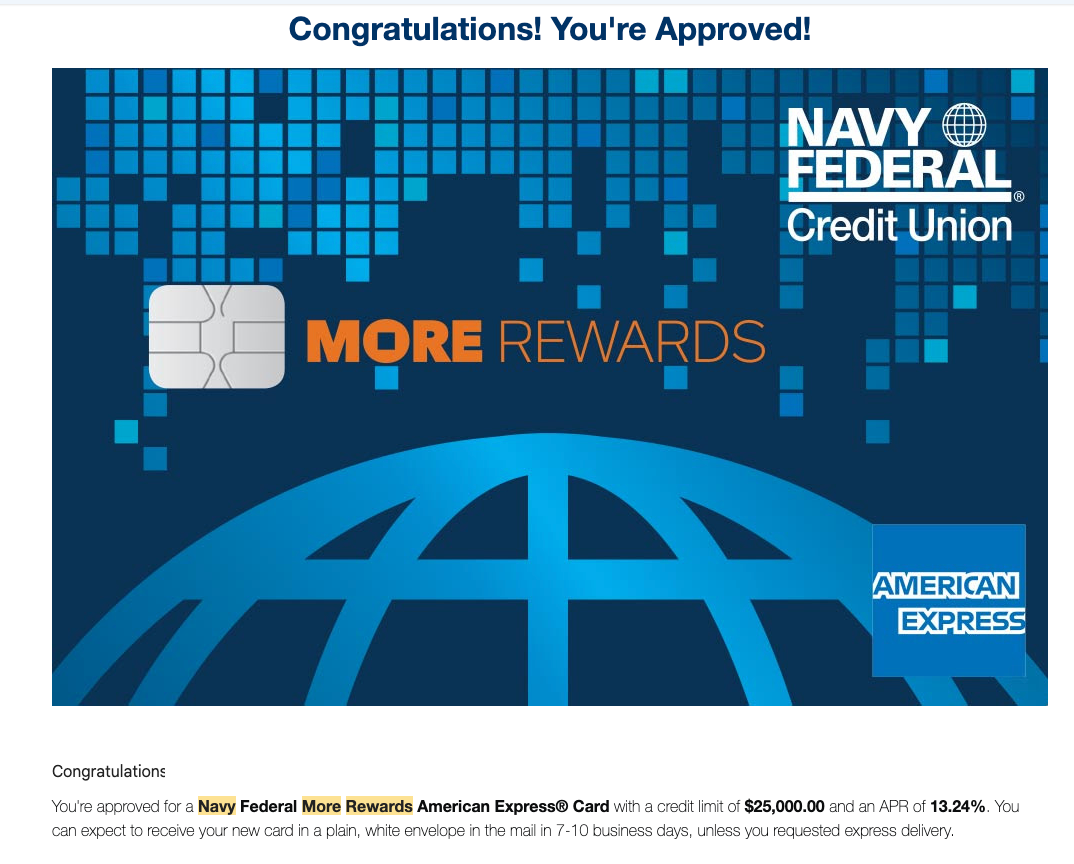
The data point says Navy Federal pulled TransUnion.
That is a massive approval.
But I do not want people reading this and thinking $25,000 is automatic after a few months.
The member reportedly had $130,000 income at the time.
That matters.
Higher income can support higher limits because the lender can justify more exposure.
They also had multiple Navy Federal relationship touchpoints before applying.
So the approval was not just about a score.
It was the full package:
-
Stronger FICO score
-
Income
-
Checking activity
-
Savings
-
Pledge loan
-
Bill pay
-
Direct deposit
-
Certificate
-
Internal relationship
-
Preselected offer
That is why the result was so strong.
Why They Canceled a 24-Year Capital One Card
After the Navy Federal approval, the member canceled a 24-year-old Capital One account.
They had apparently been stuck in a low-growth Capital One bucket for years with no real path forward.
A lot of people panic when they hear that.
They think closing an old card automatically destroys your average age of accounts.
But that is not usually how it works right away.
Experian says closed accounts in good standing can remain on your credit report for up to 10 years and may continue helping your scores during that time.
The bigger immediate issue is usually utilization.
When you close a card, you lose that available credit line.
If the card had a large limit, your utilization could jump.
But if the card had a tiny limit and your overall credit profile is already strong, the impact may be small.
So closing an old card is not always the end of the world.
Just do the math first.
October 20, 2022: Approved for $25,000 Flagship
Then the member waited about four months.
On October 20, 2022, they applied for Navy Federal’s Visa Signature Flagship Rewards Card.
They were approved again.
Another $25,000 starting limit.
That brought the total to:
-
More Rewards: $25,000
-
Flagship: $25,000
Total Navy Federal credit card limits:
$50,000
And they did it in about 7 months and 13 days.
That is the kind of data point that makes people pay attention.
Because in the same amount of time, many people are just hoping for their first small credit limit increase.
This person had built a full Navy Federal relationship and landed two major approvals.
Navy Federal Card Limits and Timing Rules
Navy Federal currently says members can be the primary cardholder on up to 3 Navy Federal credit cards.
They also say they will approve only 1 new credit card per member within a 90-day period.
That timing rule matters.
The member waited from late June to late October before going for the second card, which gave the relationship time to breathe.
Navy Federal also says current credit card APRs do not exceed 18%.
That is one reason people love credit union credit cards.
Even when rates are high across the market, Navy Federal’s card APRs can be more controlled than many bank cards and store cards.
Why This Strategy Worked
This strategy worked because the member did not treat Navy Federal like a one-night stand.
They treated it like a serious banking relationship.
They gave Navy Federal deposits.
They used checking.
They used savings.
They opened a credit product.
They opened a pledge loan.
They used bill pay.
They moved direct deposit.
They opened a certificate.
Then they applied after signals had time to build.
That is the difference.
Most people join a credit union and apply immediately.
Then they get mad when the limit is low.
This person built the file first.
What You Should Not Copy Blindly
This data point is impressive, but do not copy everything without thinking.
Do not open products you do not understand.
Do not take hard pulls casually.
Do not open a pledge loan if you cannot afford the secured funds.
Do not use credit card funding unless you know whether it will code as a purchase or cash advance.
Do not close old cards without checking utilization.
Do not assume a 38-point score jump.
Do not assume $25,000 approvals.
Do not max out a high-limit card just because you got approved.
A $50,000 credit limit is powerful.
But if you run it up without a payoff plan, it can destroy your finances.
High limits are tools.
Not trophies.
How I Would Recreate This Strategy Today
If I were trying to build a Navy Federal relationship from scratch, I would keep it simple.
First, I would open checking and savings.
Then I would fund the accounts and keep money moving through them.
Next, I would set up real direct deposit if possible.
Then I would use bill pay or normal debit activity so the account looks alive.
After that, I would consider a pledge loan only if it fits my credit profile and I understand how it works.
Then I would wait for prequalification, preselected offers, or enough relationship history before applying.
I would not rush.
Navy Federal can be generous, but timing matters.
What to Do Before Applying for Navy Federal Cards
Before applying, check:
-
Your FICO scores
-
Your utilization
-
Your recent inquiries
-
Your debt-to-income
-
Your Navy Federal relationship history
-
Whether you have direct deposit
-
Whether you have active checking usage
-
Whether you prequalify
-
Whether you opened another Navy Federal card within 90 days
-
Whether your income supports the limit you want
Do not apply just because someone else got $25,000.
Apply when your file makes sense.
Helpful resource: If you want to compare high-limit credit union options beyond Navy Federal, my 150+ Credit Unions Anyone Can Join Database can help you research more credit unions, membership paths, and card options.
Frequently Asked Questions
Can you get a $50,000 credit limit with Navy Federal?
Yes, it is possible to have $50,000 or more in total Navy Federal credit card limits, but it is not guaranteed. The data point in this article involved two $25,000 approvals after months of relationship-building, strong income, and improved credit.
How many Navy Federal credit cards can you have?
Navy Federal currently says members can be the primary cardholder on up to 3 Navy Federal personal credit cards. Navy Federal also says it will approve only 1 new credit card per member within a 90-day period.
Does Navy Federal prequalification affect your credit score?
Navy Federal says members can check whether they prequalify before applying and that the prequalification pulls information without affecting your credit score. But prequalification does not guarantee approval.
What credit bureau does Navy Federal pull?
The data point in this article reported TransUnion hard pulls for the checking line of credit and More Rewards card. Bureau pulls can vary by product, state, timing, and profile, so verify before applying.
What is a Navy Federal pledge loan?
A pledge loan is a secured loan backed by your own funds. Members often use it to build credit history, add installment loan reporting, and build relationship history with Navy Federal.
Will closing an old credit card hurt my credit score?
It can, mainly if losing the credit line increases your utilization. Experian says closed accounts in good standing can stay on your credit report for up to 10 years and may continue helping your scores during that time.
Conclusion
This Navy Federal data point is powerful because it was not random.
The member built a relationship first.
Then they applied.
That is how they went from joining Navy Federal to holding $50,000 in credit card limits in about 7.5 months.
Checking.
Savings.
Activity.
Pledge loan.
Bill pay.
Direct deposit.
Certificate.
Preselected offer.
Then the cards.
That does not mean everyone can copy the exact timeline or get the exact same limits.
But the strategy is clear.
If you want Navy Federal to treat you like a serious member, act like a serious member before you ask for serious credit.
Build the relationship.
Clean up your profile.
Watch your timing.
Use prequalification.
And never forget:
A high credit limit is only valuable if you manage it like a grown adult.