
Mesa Homeowners Card Shut Down: What Cardholders Should Learn
Jun 30, 2026
This one caught everyone off guard.
A long-time community member named Joe sent me an email with the subject line:
“URGENT NOTICE: Closure of Your Mesa Homeowners Card Account.”
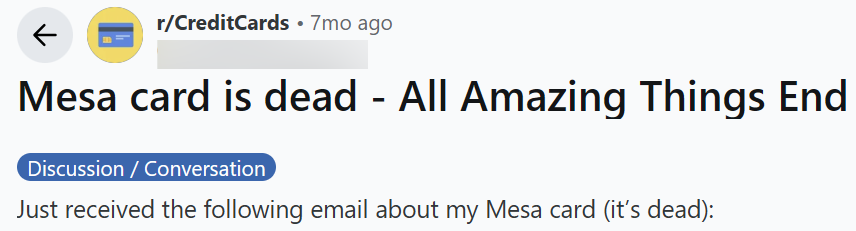
That is the kind of subject line that ruins your morning.
At first, it looked like maybe one person had a weird account issue.
Then the forums started lighting up.
People were reporting the same thing:
Accounts closed.
Cards deactivated.
No warning.
And then Mesa confirmed it.
As of December 12, 2025, all Mesa Homeowners Card accounts were closed at the company level.
This was not about one person’s behavior.
It was the entire card program.
Quick Answer
Mesa shut down all Mesa Homeowners Card accounts effective December 12, 2025, deactivated the cards, stopped new purchases, and ended new Mesa Points earning. The shutdown was not tied to individual account behavior; Mesa described it as a business decision to close the Homeowners Card program entirely. The biggest lesson is simple: do not hoard points in young or unproven rewards ecosystems, especially when transfer access can disappear quickly.
Disclosure: This article may contain affiliate links, which means I may earn compensation if you click or apply through certain links.
Helpful resource: If you want backup credit card options before relying too heavily on one card or fintech program, my Free Credit Card & Loan Pre-Approval Master List can help you research cards that may let you check offers before applying.
What Happened to the Mesa Homeowners Card?
Mesa closed the entire Homeowners Card program.
That means cardholders could no longer:
-
Make new purchases
-
Use the physical card
-
Use the card online
-
Earn new Mesa Points
-
Count on the card for future mortgage or homeowner rewards
Mesa’s message said all accounts were closed and all cards were deactivated.
That is about as final as it gets.
And the worst part for cardholders was how sudden it felt.
People were not given a long runway.
They were not told, “You have 60 days to redeem points.”
They woke up to a shutdown.
That is why people were mad.
This Was Not an Individual Account Shutdown
This part matters.
The Mesa shutdown was not because one person broke a rule.
It was not because Joe missed a payment.
It was not because one person abused the card.
Mesa said this was not tied to individual account standing or wrongdoing.
This was a company-level decision.
That makes it very different from a normal credit card shutdown.
A normal shutdown might happen because of fraud concerns, missed payments, returned payments, cycling, risk reviews, or terms violations.
This was bigger.
The entire product got pulled.
Why People Cared About Mesa
Mesa had a cult-like following because it tried to do something different.
It was basically trying to reward homeowners the way Bilt rewards renters.
That got people excited.
Homeowners spend a lot of money every month on things like:
-
Mortgage payments
-
Home improvement
-
Utilities
-
Daycare
-
Groceries
-
Gas
-
EV charging
-
Home maintenance
Mesa tried to turn those expenses into rewards.
And not just basic cash back.
Mesa Points had transfer partners, which made the card feel more serious to points-and-miles people.
That is why the card got attention fast.
Why the Card Had So Much Potential
The Mesa Homeowners Card was interesting because it attacked a real problem.
Renters had Bilt.
Homeowners wanted something similar.
If you are paying a mortgage every month, earning rewards on that payment sounds amazing.
A mortgage is usually one of the biggest monthly expenses in a household.
So a card that can reward that spend has obvious appeal.
Mesa also had transfer partners that made the points feel more valuable than basic cash back.
That gave people hope that Mesa could become a real player if it survived long enough.
But that is the key phrase:
If it survived.
Joe’s Real-World Mesa Data Point
Joe was not using Mesa as a throwaway card.
He is a real estate investor.
For him, Mesa had real utility.
He used it like a 3x Home Depot card.
He also had a $10,000 mortgage, which put him on pace for roughly 100,000 points per year from the mortgage side alone.
That is not small.
That is a serious rewards stream.
And then it disappeared.
What stood out to Joe was not just the shutdown.
It was how sudden it felt.
In hindsight, there were cracks.
But nothing screamed:
“This card is about to die.”
The Cracks People Missed
Joe mentioned a few warning signs.
Larger purchases were getting declined with no easy way to approve them.
The app felt unfinished.
Some features seemed missing.
It felt like the product was maybe 80% built.
But that is common with fintech products.
A slick app can still have weak backend systems.
A great rewards idea can still have poor controls.
A strong marketing pitch can still hide shaky economics.
That is the danger with young fintech cards.
They can look polished on the outside while the business model is still being tested underneath.
The Real Problem: The Math May Not Have Worked
Here is the uncomfortable truth.
Mesa may have been too easy to game.
In the credit card world, if a loophole exists, people will find it.
Mesa allowed users to earn points tied to mortgage spend even though the mortgage payment did not necessarily have to be charged directly to the card.
That creates a big problem.
Rewards programs only work when the economics work.
If a company is giving away too much value without enough margin, verification, or friction, the model can break fast.
That is likely what happened here.
The card had a great pitch.
But the business math may not have been strong enough to survive.
Why Mortgage Rewards Are So Hard
Mortgage payments are huge.
That is what makes them attractive for rewards.
But that is also what makes them dangerous for rewards companies.
If someone has a $10,000 monthly mortgage and earns points on that spend, the rewards liability adds up fast.
Now multiply that across thousands of cardholders.
If the company is not making enough money on card spend, interchange, fees, partnerships, or other revenue, those points become expensive.
Very expensive.
That is why mortgage rewards are hard to build sustainably.
The opportunity is huge.
But the cost is huge too.
Where It Really Hurt: Trapped Points
The shutdown itself was bad.
But the points situation was worse.
Once accounts were closed, people started reporting that:
-
Transfer buttons disappeared
-
Redemptions stopped working
-
Point balances were stuck
-
Transfer options were inconsistent
-
People had no clear timeline
Some cardholders had large balances.
Not just a few thousand points.
Some people reportedly had hundreds of thousands of Mesa Points.
Others had even more.
And when a rewards program shuts down, the fear is always the same:
Are these points about to become worthless?
What Mesa Said About Remaining Points
In the initial shutdown message, Mesa said it would provide separate guidance about remaining Mesa Points balances.
That was not enough for people sitting on large balances.
Cardholders wanted to know:
-
Can I transfer points?
-
Can I cash out?
-
Will points be honored?
-
Will points be forfeited?
-
What is the deadline?
-
What is the redemption value?
-
Are travel partners still available?
At first, the guidance was not clear enough.
So people did what points people always do.
They started testing everything.
The Community Found Temporary Workarounds
Some cardholders started looking for ways to move points before everything shut down completely.
The workarounds did not work for everyone.
Some failed.
Some only worked briefly.
Some depended on app behavior that may already be gone.
But the fact that people had to resort to tricks at all shows how messy the shutdown felt.
When a card program closes overnight and points access gets unclear, people panic.
And honestly, I understand why.
Workaround #1: The App Glitch Transfer Method
The biggest workaround people discussed was an app glitch method.
Some users said they could sometimes make the transfer screen appear again by reinstalling the app and toggling internet access on and off while moving through the rewards section.
The reported process looked something like this:
-
Delete the Mesa app
-
Reinstall it
-
Turn off Wi-Fi and cellular
-
Open the app offline
-
Turn internet back on and log in
-
Turn internet off again
-
Go to the rewards section
-
Turn internet back on
-
Scroll quickly to the transfer screen
-
Transfer points immediately if the option appears
Some people said they only had seconds before the transfer screen disappeared again.
That is not a normal rewards experience.
That is chaos.
And it shows why you cannot wait around when a fintech rewards program starts breaking.
Workaround #2: Cashing Out Points
If transfers were not available, some people cashed out.
The value was not exciting.
The reported cashout value was roughly 0.6 cents per point.
That is not what points collectors want.
Transferable points are usually most exciting because they can become airline miles or hotel points.
Cashing out at a low value feels like giving up upside.
But if the alternative is losing the points entirely, cash is better than nothing.
Sometimes the boring option is the smart option.
Workaround #3: Smaller Transfers
Some users also reported better luck moving points in smaller chunks.
Large transfers sometimes failed.
Smaller transfers occasionally slipped through.
This is a common panic move when a system is breaking.
Instead of trying to move 300,000 points at once, people try 10,000 or 25,000 at a time.
It is not ideal.
It is not guaranteed.
But when the program is closing, people are not trying to optimize anymore.
They are trying to escape.
What Eventually Happened to Remaining Points
Frequent Miler later reported that Mesa updated its FAQ and said remaining eligible points would be converted to statement credits for cardholders who did not transfer points before transfers stopped working.
That is better than total forfeiture.
But it still may not be what cardholders wanted.
If someone planned to transfer points to airline or hotel partners, a statement credit may produce much less value than the redemption they had in mind.
That is the problem with waiting.
The program may give you something.
But it may not be the thing you wanted.
The Bigger Lesson: Do Not Hoard Points in Unproven Programs
This is the rule:
Never hoard points in unproven ecosystems.
I do not care how exciting the card looks.
I do not care how slick the app is.
I do not care how good the transfer partners are.
If the program is young, fragile, or backed by a fintech with uncertain economics, do not treat those points like Chase Ultimate Rewards or Amex Membership Rewards.
Have a plan.
Where are the points going?
When will you transfer them?
What redemption are you targeting?
What is your exit strategy if the program changes?
If you cannot answer those questions, you are taking more risk than you think.
Safer Points Ecosystems Are Different
There is a reason people trust points from larger ecosystems more.
Programs like:
-
Chase Ultimate Rewards
-
Amex Membership Rewards
-
Citi ThankYou Points
-
Capital One Miles
are not risk-free.
No rewards program is risk-free.
Transfer partners can change.
Redemption values can drop.
Rules can tighten.
Accounts can be reviewed.
But large bank-backed ecosystems are usually more stable than a young fintech card program built around an aggressive rewards model.
That does not mean you should hoard points forever.
It means the risk level is different.
What This Means for Bilt
Mesa immediately made people think about Bilt.
That is fair.
Bilt is also a fintech-style rewards program built around a major housing expense.
But I want to be clear.
I do not think Bilt is going away tomorrow.
Bilt is more established, has stronger visibility, and has major partnerships.
But the Mesa shutdown is still a reminder.
Young rewards ecosystems can change quickly.
Products can be reworked.
Partners can change.
Backend banks can shift.
Earning rules can tighten.
Redemption options can get worse.
That is not panic.
That is reality.
So if you are using Bilt and you know you want Hyatt, airline miles, or another specific transfer partner, have a plan.
Do not let points sit forever just because the app looks nice.
Fintech Cards Can Change Fast
This is the part people need to understand.
Fintech cards are not the same as traditional bank cards.
Many fintech cards rely on:
-
Partner banks
-
Program managers
-
Venture funding
-
Interchange economics
-
Rewards partnerships
-
App-based servicing
-
Third-party underwriting
-
Backend processors
That creates more moving pieces.
And when one piece breaks, the whole product can change quickly.
That does not mean fintech cards are bad.
Some are useful.
But they carry a different kind of risk.
The app may be beautiful.
The branding may be clean.
The rewards may look amazing.
But if the business model does not work, the card can disappear.
What Cardholders Should Do After a Shutdown
If a card you use gets shut down suddenly, move fast.
Here is the basic checklist:
-
Screenshot the shutdown email
-
Screenshot your points balance
-
Screenshot recent transactions
-
Download statements
-
Try official redemption options first
-
Transfer points if transfers are still available
-
Cash out if transfers are gone and cashout works
-
Update autopay or subscriptions
-
Remove the card from digital wallets
-
Watch your credit report
-
Save all communications
-
Pay any remaining balance on time
Do not assume the app will stay usable.
Do not assume points will remain accessible.
Do not assume customer service will give clear answers immediately.
Move quickly and document everything.
Why Backup Cards Matter
This is exactly why I always say you should not rely on one card.
If Mesa was your main Home Depot card, now you need a replacement.
If it was your mortgage rewards strategy, now that strategy is dead.
If you had it saved for utilities, daycare, or recurring expenses, those payments may need to be moved.
That is why backup cards matter.
Not because you need 40 cards.
But because one card can fail.
One app can break.
One issuer can change rules.
One fintech can shut down a product overnight.
A good wallet has redundancy.
How to Protect Yourself From Rewards Risk
Here is how I would protect myself moving forward:
-
Do not hoard points in young programs
-
Transfer points once you have a real use
-
Keep screenshots of balances and terms
-
Diversify across more than one issuer
-
Keep backup cards for major categories
-
Watch for app issues or declining purchases
-
Pay attention to program changes
-
Avoid building your whole strategy around one fintech
-
Redeem points before a program gets shaky
Rewards are only valuable if you can actually use them.
That is the part people forget.
A million points that cannot be transferred are not worth what you thought.
The Mesa Shutdown Was Worst-Case Scenario
An entire card program shutting down overnight is about as bad as it gets.
This was not a normal category nerf.
This was not a sign-up bonus change.
This was not a minor benefit removal.
This was the card disappearing.
That is rare.
But it is not impossible.
And once you see it happen, you should adjust how you think about risk.
Not every shiny new rewards card deserves your loyalty.
Some cards are tools.
Use them.
Earn.
Redeem.
Move on.
Do not get emotionally attached to an unproven product.
Frequently Asked Questions
Did Mesa shut down the Homeowners Card?
Yes. Mesa shut down the Mesa Homeowners Card program effective December 12, 2025. All accounts were closed and all cards were deactivated.
Why did Mesa close all accounts?
Mesa described the closure as a business decision to shut down the Homeowners Card program entirely. The closure was not tied to individual account standing or wrongdoing.
Could Mesa cardholders still use their cards?
No. Mesa said all credit cards were deactivated and cardholders could no longer make new purchases or earn Mesa Points.
What happened to remaining Mesa Points?
Mesa initially said it would provide separate guidance on remaining Mesa Points balances. Frequent Miler later reported that Mesa said remaining eligible points would be converted to statement credits for cardholders who did not transfer points before transfers stopped working.
Why were Mesa points so valuable?
Mesa Points were interesting because the card rewarded homeowners for mortgage and home-related spending and offered transferable points to travel partners. Transferable points can sometimes be worth more than simple cash back if used well.
Should I avoid fintech credit cards?
Not necessarily. Fintech cards can be useful, but they carry different risks than established bank cards. Do not hoard points in young ecosystems, keep backup cards, and redeem or transfer points when you have a clear plan.
Conclusion
The Mesa Homeowners Card shutdown is one of the clearest reminders that rewards are not guaranteed forever.
A card can look exciting.
The app can look polished.
The points can look valuable.
The transfer partners can look real.
And then the program can disappear.
Mesa had potential.
It tried to reward homeowners in a way few cards had done before.
But the model may have been too aggressive, too easy to game, or simply not profitable enough to survive.
Whatever the reason, cardholders were left scrambling.
So take the lesson.
Do not hoard points in unproven ecosystems.
Do not rely on one card.
Do not assume a fintech card is as stable as a major bank rewards program.
And if you know where you want your points to go, move them before you are forced to take whatever option is left.
Because points are only valuable when you can actually use them.