
4 EIN-Only No PG Business Cards With No Hard Pull
Jun 29, 2026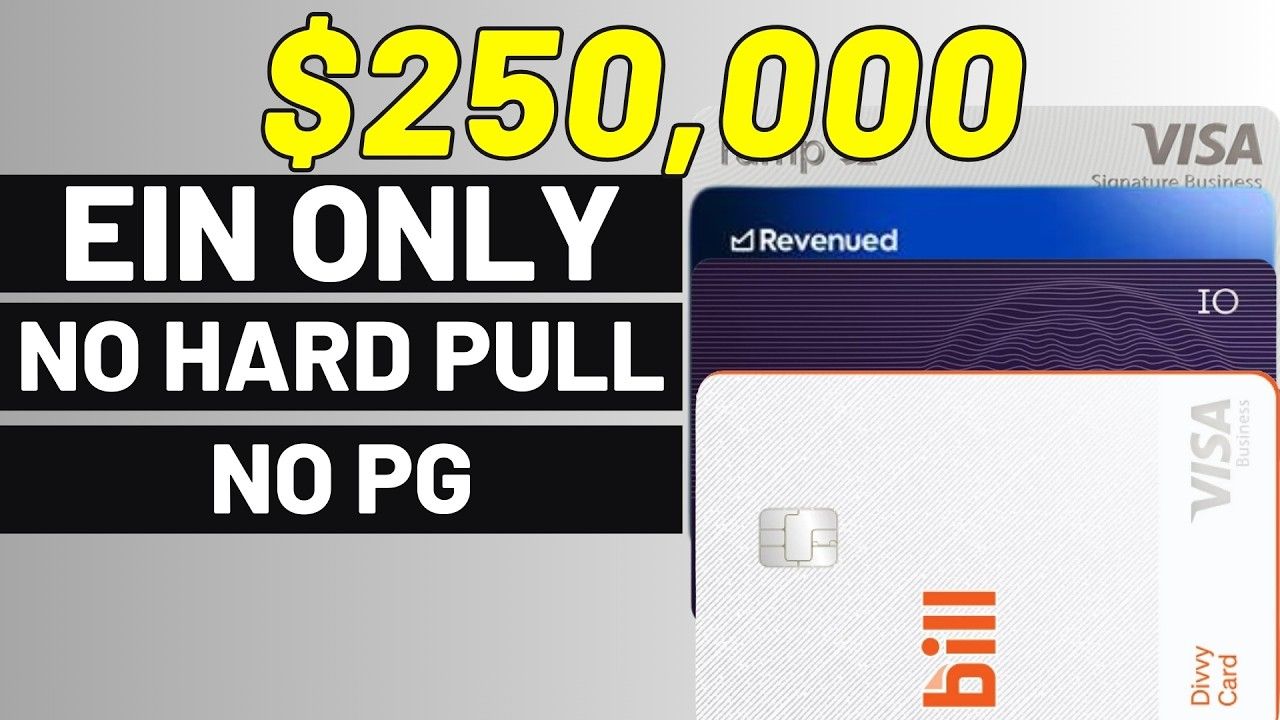
If you want business credit without putting your personal credit on the line, EIN-only no PG business cards are some of the most powerful tools you can find.
The problem?
Most business credit cards still want your Social Security number, a personal guarantee, and a hard pull on your personal credit.
That defeats the whole purpose for a lot of business owners.
The cards in this article are different. These are business cards and funding products that may let you apply with no hard pull, no personal guarantee, and no personal credit reporting. That means your personal credit score may not take damage just for applying.
But do not get it twisted.
These cards are not magic. You still need real business activity, business revenue, a business bank account, and in some cases, a serious cash balance.
Disclosure: This article may contain affiliate links, which means I may earn compensation if you click or apply through certain links.
Quick Answer
The four EIN-only no PG business cards covered here are BILL Divvy, Ramp, Revenued Flex Line, and Mercury IO. These options may not require a hard pull on your personal credit and may not require a personal guarantee, but they usually underwrite based on your business revenue, business bank balance, cash flow, and business history. Divvy is often the easiest for newer LLCs, while Ramp and Mercury IO usually require much stronger business cash reserves.
What Does EIN-Only No PG Mean?
EIN-only means the lender is primarily evaluating your business instead of treating the account like a personal credit card application.
No PG means no personal guarantee.
A personal guarantee makes you personally responsible for the debt if the business does not pay. So when a card has no PG, the lender is not asking you to personally guarantee repayment in the same way a traditional business card would.
That matters because most popular business credit cards still require a personal guarantee.
Even if the card does not report to your personal credit, you may still be personally liable for the balance. That is why true no PG business credit is so attractive.
With the cards below, approval is mainly based on business factors like:
-
Business revenue
-
Business bank balance
-
Cash flow
-
Time in business
-
Business structure
-
Business banking history
-
Linked financial accounts
-
Business credit data
That is why having a real business foundation matters.
Why No Hard Pull Business Cards Are So Valuable
A hard pull can hit your personal credit report and potentially lower your score. That is not what you want if you are building a funding strategy, applying for multiple cards, or trying to keep your personal credit clean.
No hard pull business cards can help because they may let you apply without damaging your personal score.
That gives business owners more flexibility.
But there is a tradeoff.
No hard pull and no PG cards often have stricter business requirements. Instead of leaning on your personal credit, the lender wants to see that your business can actually support the credit line.
That is why many of these cards require linked bank accounts, revenue verification, or minimum cash balances.
Helpful resource: If you want more EIN-only and no PG options, my No PG Business Credit Card Master List can help you compare business cards that may not require a personal guarantee.
1. BILL Divvy Card
The BILL Divvy card is one of the best starting points for newer small businesses and newer LLCs.
Out of the cards on this list, Divvy is usually the easiest one to get approved for if your business is still young.
It is a charge card with expense management features, virtual cards, spending controls, and no annual fee. It is built for businesses that want to manage spending, track expenses, and issue cards to employees or vendors.
I have had the Divvy card for over a year, and I can confirm there was no hard credit pull on my personal credit when I got it.
My business was approved for a $2,000 starting limit.
BILL Divvy Credit Limits
Divvy credit limits can range from $500 to $5 million, with automated approvals up to $400,000.
After reviewing 10 recent approvals, the average starting limit was around $12,500.
That does not mean every business will get that amount. Your approval and limit can depend on your business profile, revenue, business bank balance, and how strong your financials look.
One strong data point showed someone being approved within 24 hours for a $50,000 limit. They said they asked for $50,000 expecting a counteroffer, but got approved for the full amount.
That is why Divvy can be powerful if your business profile is ready.
How to Increase Your Divvy Limit
The simplest way to increase your Divvy limit is to use the card more and show the business can handle the spending.
One data point said:
“Received a Divvy CLI from $2k to $3k. Rep said I should use it more to receive a higher spend.”
That makes sense.
If your business barely uses the card, Divvy may not have a strong reason to give you more credit. But if you use it responsibly, pay as required, and keep strong business banking activity, you may have a better shot at a higher limit.
BILL Divvy Features
Divvy is not just a business card. It is also an expense management platform.
Key features include:
-
Automated expense management
-
Budgeting by project, team, or category
-
Spending controls for employees
-
Free virtual and physical cards
-
Real-time transaction tracking
-
No annual fee
-
Rewards program
-
Reporting to the Small Business Financial Exchange, also called SBFE
The virtual cards are one of the biggest benefits.
You can create different virtual cards for different vendors, subscriptions, ad accounts, or employees. That helps protect your main account and gives you much better control over business spending.
If a vendor overcharges you, or if a card number gets exposed, you can shut down that one virtual card without wrecking your whole business payment system.
That is a real advantage.
Helpful resource: You can review the BILL Divvy card here if you want a no PG business card option with expense management and virtual cards.
BILL Divvy Qualifications
Divvy usually wants to see that you have a real business.
Based on the original data, you may need:
-
A registered LLC or corporation
-
A U.S.-based business
-
Business financial activity
-
A business bank account
-
A personal credit score that may be as low as 580, though 640 or higher may improve approval chances
-
At least a few thousand dollars in the business bank account, based on data points
One data point said they applied for Divvy on the same day they got their LLC and EIN and were approved. They also said Divvy did not hard pull personal credit.
That is why Divvy gets so much attention from newer business owners.
But I would still treat that as a data point, not a guarantee. A brand-new LLC with no money, no revenue, and no activity is still going to be weaker than a business with deposits, spending, and cash flow.
Watch Out for Divvy Rewards
The biggest issue with Divvy is the rewards system.
I view Divvy mostly as a no-rewards card.
The rewards can look good at first, but the rules can be annoying. You may need to spend at least 30% of your credit limit in a month to qualify for rewards. If you do not meet the requirement, your rewards can be reduced or clawed back.
One user said their business lost over 40,000 points because they spent just under 30% of the credit limit one month.
That is brutal.
Divvy points also have different values depending on how you redeem them:
-
Travel booked through Divvy may get the highest value
-
Cash back or statement credit may be worth less
-
Gift cards may also redeem at a lower value
-
Points cannot be transferred to airline or hotel partners
-
Weekly payment cycles may earn more points than monthly cycles
So if you get Divvy, get it for the approval path, no hard pull potential, no PG structure, virtual cards, and expense controls.
Do not get it because you think it is going to be a monster rewards card.
2. Ramp Card
Ramp is a stronger option for businesses with higher revenue, stronger cash reserves, and more serious company spending.
If your business is running real numbers and you want a much higher credit limit, Ramp may be the best card on this list.
But it is also harder to qualify for.
Ramp is a corporate charge card with unlimited virtual and physical cards, expense management, accounting tools, receipt matching, spending controls, and 1.5% cash back.
It does not work like a traditional credit card where you carry a balance and pay interest. It is a charge card, so the balance must be paid in full each billing cycle.
Ramp Credit Limits
Ramp credit limits can go as high as $2 million, based on the original content.
Ramp looks at several business factors when setting your limit, including:
-
Business bank balances
-
Industry
-
Business credit history
-
Financial health
-
Liquid assets
-
Debts and liabilities
-
Spending patterns
-
Annual revenue
-
Monthly expenses
-
Linked banking and accounting data
Ramp is very data-driven.
The more financial visibility you give them, the better they can understand your business. If your business has strong cash, clean financials, and solid revenue, Ramp can offer much higher limits than many traditional business credit cards.
One data point reported a $33,800 starting limit with Ramp, no personal credit reporting, and no hard pull on personal credit.
That is exactly why business owners like Ramp.
How to Increase Your Ramp Limit
Ramp may adjust your limit as your business finances change.
If your assets grow, your revenue increases, or you connect more financial data sources, Ramp may reevaluate your business and increase your limit.
You can also contact Ramp support, your Account Manager, or your Customer Success Manager and ask for a limit review.
That is one of the benefits of Ramp.
It is not just looking at a static credit profile. It can adjust based on what your business is doing right now.
Ramp Features
Ramp has some of the strongest business management features on this list.
Key features include:
-
$0 annual fee
-
Unlimited 1.5% cash back
-
No APR because it is a charge card
-
No foreign transaction fee
-
Unlimited virtual and physical cards
-
Expense controls
-
Automatic receipt matching
-
Approval workflows
-
Expense categorization
-
Accounting integrations
Ramp also claims businesses can save money through better spending controls and automation.
That is where Ramp shines.
This is not just a card for one-person side hustles. It is built for businesses with teams, vendors, subscriptions, software costs, travel, ads, and ongoing operating expenses.
One customer data point said they switched to Ramp with 70 employees and had zero issues with expense reports because everything was automated. Another said their 30-person company was able to get set up pretty quickly with help from a Ramp specialist.
That matters if you have employees and want a cleaner way to manage spending.
Helpful resource: You can review Ramp if your business has strong cash reserves and you want a no PG corporate card with higher limit potential.
Ramp Qualifications
Ramp is not for every business.
Based on the original content, Ramp may require:
-
A U.S.-registered business
-
Corporation, LLC, limited partnership, or nonprofit structure
-
EIN
-
Most business operations and spending in the U.S.
-
At least $75,000 in cash in linked U.S. business bank accounts
-
No sole proprietors or unregistered businesses
One interesting point is that you may not need to be a U.S. citizen to qualify.
If you are a business owner or officer without a Social Security number, you may be able to apply using foreign passport information and documentation to verify your address.
That is a big deal for some founders.
Watch Out for Ramp’s Cash Requirement
The biggest issue with Ramp is the $75,000 cash requirement.
That is going to knock out a lot of newer small businesses.
Ramp does not just want to see that your business exists. It wants to see real cash reserves.
For a business with strong revenue and healthy bank balances, Ramp can be powerful. But for a brand-new LLC with a few hundred dollars in the bank, Ramp is probably not the move yet.
3. Revenued Flex Line
Revenued is different from Divvy and Ramp.
The Revenued Card and Flex Line is more like a hybrid between a business line of credit and a business card.
That makes it useful if you need access to cash, not just card spending.
You can use it anywhere Visa is accepted, but you may also be able to pull cash into your business account.
That flexibility is what makes Revenued interesting.
But it also comes with a major warning: the cost can be high.
Revenued Credit Limits
Revenued says funding can go up to $250,000.
Your credit limit is based on business banking history, monthly revenue, bank account balance, and financial fluctuations.
One data point said:
“So, I applied for the Revenued Card & Flex Line and was approved for a 13k SL.”
That shows Revenued can work for real funding, but you need to pay close attention to the repayment terms.
How to Increase Your Revenued Limit
The best way to increase your Revenued limit is to improve your business financial health.
That means:
-
Increase monthly revenue
-
Keep higher business bank balances
-
Avoid negative balance days
-
Maintain stable cash flow
-
Keep your business bank account active and healthy
Revenued adjusts based on how your business is doing. So if your bank account looks stronger, your limit may have more room to grow.
Revenued Features
Revenued can be attractive because it focuses more on business performance than perfect personal credit.
Key features include:
-
Up to $250,000 in funding
-
Soft credit pull
-
No personal guarantee
-
Available to some business owners with poor credit
-
Hybrid card and credit line structure
-
Cash withdrawals and card payments
-
Flexible usage anywhere Visa is accepted
-
Repayment plans based on business cash flow
-
Reports to SBFE
-
Dedicated account management
This is why Revenued can be useful for businesses that need working capital but may not qualify for traditional bank lines of credit.
Helpful resource: You can review Revenued if your business needs a no PG funding option that works more like a card and cash-access line.
Revenued Qualifications
Based on the original content, Revenued may require:
-
A registered U.S. business entity, such as an LLC
-
At least 6 months in business
-
Business bank account
-
Less than 3 days in the negative per month
-
At least $20,000 in monthly revenue
-
Minimum average daily balance of $1,000
-
Soft credit pull
-
No personal guarantee
-
Most industries accepted, except certain financial institutions like banks or business lenders
That $20,000 monthly revenue requirement is important.
Revenued may be open to weaker credit, but it still wants real business revenue.
Watch Out for Revenued Costs
This is the biggest warning in the whole article.
Revenued can be expensive.
One customer data point said they were approved for a $13,000 starting line with a 0.45 factor rate and daily repayment.
That means the cost can feel very high compared to traditional business credit cards or lower-cost lines of credit.
In the example from the original content, if they used $1,000 and carried it for 5 months, they would repay $1,450. They also said Revenued would auto-draft daily from the business checking account.
That is not cheap funding.
So I would not look at Revenued like a normal credit card.
This is more of a working capital tool. It may make sense if the money helps you generate a clear return. But if you are using it to patch weak cash flow without a plan, it can get dangerous quickly.
4. Mercury IO Card
The Mercury IO card is another interesting option for startups and small businesses.
This is a charge card connected to Mercury’s business banking platform.
The big idea is simple: Mercury can understand your financial position because your business cash is held inside Mercury. That may allow them to offer a credit limit without relying on your personal credit score.
I qualified for this card myself.
I was approved for a $6,000 limit just days after depositing $25,000 into a Mercury business checking account.
Mercury IO Credit Limits
The Mercury IO card does not have a traditional preset spending limit.
Your limit can adjust based on your spending habits and the financial health of your business.
Because your limit is tied to your Mercury account balance, your limit may increase if your Mercury balance increases. But it can also decrease if you withdraw money or your cash position weakens.
Mercury currently reassesses limits after large deposits and withdrawals, based on the original content.
That is very different from a traditional business credit card.
With Mercury IO, your cash balance matters a lot.
Mercury IO Features
Mercury IO includes:
-
1.5% cash back on all purchases
-
Automatic redemptions
-
Spend management tools
-
Employee spending controls
-
Physical and virtual cards
-
Mercury business checking
-
FDIC insurance coverage through Mercury’s partner banking structure
This can be a clean setup if you are already using Mercury for business banking or if you are comfortable moving cash into a Mercury account.
Mercury IO Qualifications
Based on the original content, Mercury IO may require:
-
A Mercury business account
-
Up to $25,000 deposited into the account to become eligible
-
An average cash balance around $25,000 to keep the account active
-
No credit check during the IO card sign-up process
-
No personal credit score impact
That no-credit-check structure is the major appeal.
But the $25,000 deposit requirement is the major barrier.
Watch Out for Mercury’s Deposit Requirement
Mercury’s $25,000 requirement is lower than Ramp’s $75,000 cash requirement, but there is a major difference.
Ramp may let you link existing business bank accounts.
Mercury requires you to actually move the money into Mercury.
That is a big deal.
Moving $25,000 into a new account is not something every business owner wants to do right away. You need to be comfortable with Mercury as a business banking platform before moving that kind of cash.
So Mercury IO can be powerful, but it is not a fit for everybody.
Which No PG Business Card Is Best?
The best no PG business card depends on where your business is right now.
If you have a newer LLC and want the easiest approval path, Divvy is probably the first card to look at.
If your business has strong cash reserves and you want high credit limits, Ramp may be the strongest option.
If you need cash access and your business has strong revenue, Revenued may be worth reviewing, but you need to be very careful with the cost.
If you already like Mercury and can move $25,000 into the account, Mercury IO can be a strong no-credit-check option.
Here is the simple breakdown:
-
Best for newer LLCs: BILL Divvy
-
Best for high limits: Ramp
-
Best for cash access: Revenued Flex Line
-
Best for Mercury banking users: Mercury IO
-
Best for avoiding personal credit impact: all four may help, if you qualify through the right path
What You Need Before Applying for EIN-Only No PG Business Cards
If you want to get approved for no PG business cards, your business needs to look real.
That means you should have:
-
An LLC or corporation
-
EIN
-
Business bank account
-
Real deposits
-
Consistent revenue
-
Clean business banking history
-
Healthy cash balance
-
Business address and phone number
-
Professional website or online presence
-
Separated personal and business finances
These cards are not built for fake businesses.
They are built for real businesses with real activity.
If your business bank account has no money, no deposits, and no history, you may not get very far.
Frequently Asked Questions
Can you get business credit cards with only an EIN?
Yes, some business cards and corporate cards may underwrite mainly using your EIN, business revenue, cash flow, and business bank data. However, most traditional business credit cards still require a Social Security number and personal guarantee.
Do EIN-only business cards require a personal guarantee?
Some do not require a personal guarantee, including certain corporate cards and revenue-based business funding products. Always read the application terms carefully because many business cards still require a PG even if they do not report to personal credit.
Do no PG business cards do a hard pull?
Some no PG business cards may not hard pull personal credit. The cards covered here are known for no hard pull or soft pull structures based on the original data, but policies can change, so verify before applying.
Which no PG business card is easiest to get approved for?
Divvy is often one of the easier options for newer LLCs compared to Ramp, Mercury IO, and Revenued. Ramp and Mercury usually require stronger cash reserves, while Revenued requires stronger monthly revenue.
Do these cards report to personal credit?
The original data says these cards do not report card usage to personal credit. Some may report business activity to business credit bureaus or SBFE. Always verify current reporting policies before applying.
Can a brand-new LLC get approved for no PG business credit?
It is possible in some cases, especially with options like Divvy, based on user data points. But approval is stronger when the business has real revenue, deposits, business banking activity, and clean financial history.
Conclusion
EIN-only no PG business cards are some of the best tools for separating your business credit from your personal credit.
But the lenders are not handing out free money.
If they are not using your personal credit as the main approval factor, they need to see something else. That usually means revenue, deposits, business bank balances, cash flow, and real business history.
Divvy may be the best starting point for newer LLCs. Ramp may be the best fit for businesses with serious cash reserves. Revenued may help if you need cash access and have strong revenue. Mercury IO may be powerful if you are willing to keep a larger balance inside Mercury.
The key is knowing which card matches your business right now.
Apply for the one that fits your financial profile, not the one with the biggest advertised limit.