
What to Do If Discover Sues You for Credit Card Debt
Jun 30, 2026
Getting sued by Discover over unpaid credit card debt can feel like your whole life just got flipped upside down.
One person said they were sued for about $2,000 right before Christmas and could not even include the Discover account in their debt settlement program.
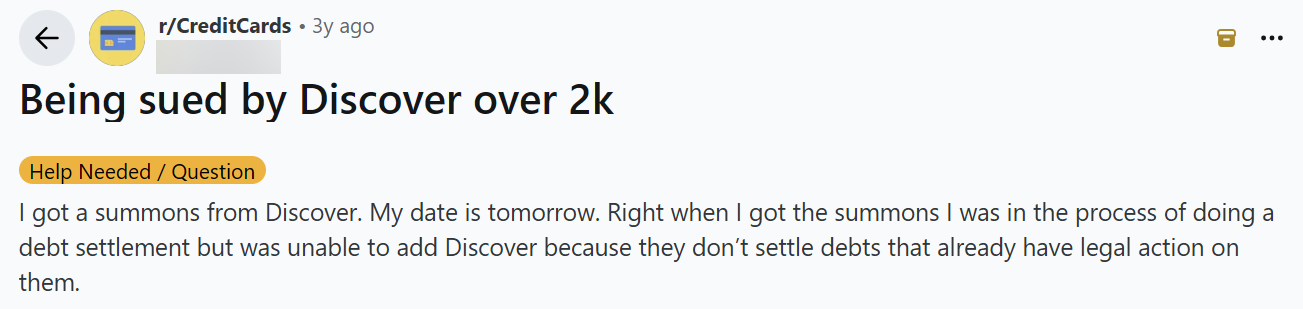
Another said their bank account was hit overnight, leaving them with almost nothing for food.
That is terrifying.
And if Discover has sued you, ignoring it is one of the worst things you can do.
A debt lawsuit can lead to a judgment.
A judgment can lead to wage garnishment, bank account levies, or liens, depending on your state and situation.
So this is not the time to freeze.
This is the time to respond, get organized, and understand your options.
Quick Answer
If Discover sues you for credit card debt, do not ignore the lawsuit. Read the papers, write down the response deadline, consider speaking with a consumer debt attorney or legal aid office, and file a formal answer with the court if required in your state. Discover is often harder to fight than a third-party debt buyer because it is usually the original creditor, but you may still be able to challenge errors, negotiate a settlement, set up a payment plan, or raise valid legal defenses.
Disclosure: This article may contain affiliate links, which means I may earn compensation if you click or apply through certain links.
Helpful resource: Before applying for another card, my Free Credit Card & Loan Pre-Approval Master List can help you check pre-approval options without guessing and avoid unnecessary hard pulls when possible.
Why Discover Lawsuits Scare People
A collection call is stressful.
A lawsuit is different.
When you get served with legal papers, the situation becomes real fast.
Now there are deadlines.
Court dates.
Legal language.
Possible judgments.
Possible garnishment.
Possible frozen bank accounts.
And if you have never been sued before, the whole process can feel like it was designed to make you panic.
That is why so many people freeze.
But freezing is exactly what Discover’s lawyers do not mind.
Because if you do nothing, Discover may be able to win by default.
The Nightmare Scenario: Sued Right Before Christmas
One Discover cardholder shared a brutal story.
They were sued for about $2,000 right before Christmas.
That amount may not sound huge to some people.
But when you are unemployed, behind on bills, and trying to keep your home, $2,000 can feel impossible.
They were already enrolled in a debt settlement program and thought they were trying to fix the problem.
Then Discover filed a lawsuit anyway.
The debt could not be handled the way they expected.
The lawsuit added pressure.
And Discover’s attorneys wanted around $175 per month, which the person said they could not afford.
That is the part people miss.
A payment that sounds “reasonable” on paper may still be impossible when someone is already choosing between food, utilities, mortgage payments, and medical bills.
Why You Cannot Ignore a Discover Lawsuit
If you ignore the lawsuit, Discover can ask the court for a default judgment.
That means Discover may win because you did not respond.
Not because you told your side.
Not because the judge reviewed your full financial life.
Not because Discover proved every detail while you fought back.
You simply did not show up in the way the court required.
That can open the door to collection tools after judgment, depending on your state.
Those may include:
-
Wage garnishment
-
Bank account levies
-
Frozen accounts
-
Property liens
-
Court costs
-
Added fees
-
More stress
So the first rule is simple:
Do not ignore the papers.
Even if you owe the debt.
Even if you are scared.
Even if you do not have the money.
Responding gives you options.
Ignoring it takes options away.
Why Discover Is Different From Some Debt Collectors
Discover is often more difficult than a random debt buyer.
Why?
Because Discover is usually the original creditor.
That means Discover may still have access to account records, statements, cardmember agreements, payment history, and internal documentation.
A third-party debt buyer may have bought an old debt for pennies on the dollar and may not have clean paperwork.
That can sometimes make debt-buyer lawsuits easier to challenge.
Discover is different.
If Discover still owns the account and sues directly, it may be more prepared.
That does not mean Discover automatically wins.
But it does mean you should take the lawsuit seriously.
Why Discover May Sue Over Smaller Balances
Some people assume a credit card company will not sue unless the balance is huge.
That is not always true.
Discover has a reputation for suing over balances that are not massive.
The script mentioned Discover lawsuits around the $1,500 to $2,000 range.
That needs verification case by case, but the practical lesson is real:
Do not assume your balance is “too small” for court.
If an account charges off and collection attempts fail, a creditor may decide it is worth filing.
That is especially true if the creditor already has a legal process built for this.
Why Discover May Move Faster Than You Expect
Discover may sue after normal collection attempts fail.
Usually, the pattern looks something like this:
-
You miss payments
-
The account becomes delinquent
-
Fees and interest build
-
Collection calls and letters start
-
Settlement offers may appear
-
The account may charge off
-
Legal action becomes more likely
The exact timeline can vary.
But once the account is seriously delinquent, do not assume you have unlimited time.
If you are behind with Discover and want to avoid court, call early and ask what options exist.
Waiting until a lawsuit arrives limits your choices.
Discover Is Not “Bad” Just Because It Sues
Let’s be fair.
Discover is not automatically a bad company.
Discover can be a strong issuer for beginners, students, and people rebuilding credit.
They offer pre-approval with no impact to your credit score.
They have popular starter cards.
They can be easier to understand than some premium issuers.
The problem usually starts when the account goes unpaid long enough that it charges off or gets escalated legally.
That is when Discover can become very aggressive.
So the lesson is not:
“Never use Discover.”
The lesson is:
Do not let a Discover account go ignored once you are in trouble.
Step 1: Read the Lawsuit Carefully
When you get served, read everything.
Look for:
-
The court name
-
Case number
-
Plaintiff name
-
Amount claimed
-
Date you were served
-
Response deadline
-
Hearing date, if listed
-
Attorney or law firm name
-
Instructions for filing an answer
Do not just skim it.
Court deadlines matter.
Missing a deadline can cost you.
If you do not understand the papers, contact the court clerk, a legal aid office, or a consumer debt attorney.
Court clerks usually cannot give legal advice, but they may explain filing procedures and deadlines.
Step 2: File an Answer by the Deadline
An answer is your formal response to the lawsuit.
This is how you tell the court you are not ignoring the case.
Depending on your state, your answer may admit, deny, or state that you do not have enough information to admit or deny each claim.
You may also raise defenses if they apply.
Possible issues to review include:
-
Wrong amount
-
Wrong person
-
Improper service
-
Statute of limitations
-
Payments not credited
-
Identity theft
-
Account not yours
-
Missing documentation
-
Arbitration clause
-
Bankruptcy discharge
-
Settlement agreement already made
Do not invent defenses.
But do not assume Discover’s paperwork is perfect either.
The point of responding is to make them prove the case.
Step 3: Do Not Confuse Debt Validation With a Court Answer
A lot of people hear “send a debt validation letter” and think that solves everything.
Be careful.
Debt validation letters can be useful in some collection situations, especially with debt collectors.
But if you have already been sued, a debt validation letter does not replace your court answer.
You still need to respond to the lawsuit by the court deadline.
Also, Discover is often the original creditor, not a third-party debt collector.
That can change which federal debt collection rules apply.
So yes, you can ask for proof.
You can request account documents.
You can ask for a breakdown of the amount.
But do not rely on a letter alone if court papers have already been served.
The court deadline is the deadline that matters.
Step 4: Gather Your Documents
Start building a file.
Collect:
-
The lawsuit papers
-
Discover statements
-
Payment history
-
Settlement letters
-
Hardship emails
-
Debt settlement program documents
-
Bank records
-
Proof of unemployment or reduced income
-
Medical bills, if relevant
-
Any letters from Discover or its attorneys
-
Any proof the amount is wrong
-
Any proof the account is not yours
Do not walk into court empty-handed.
Even if you are negotiating, documentation matters.
The more organized you are, the better you can explain your situation.
Step 5: Explore Settlement Options
You may be able to settle before the case goes further.
Settlement can happen before court, during court, or sometimes after a judgment.
The best deal depends on your situation.
Common settlement options include:
-
Lump-sum settlement
-
Monthly payment plan
-
Reduced balance settlement
-
Stipulated agreement
-
Hardship-based payment plan
The script mentioned seeing Discover settlements as low as 40% of the original debt and payment plans as long as 24 months.
Those are data points, not guarantees.
Your result can vary by balance, hardship, attorney, state, timing, and Discover’s internal guidelines.
Get any agreement in writing before paying.
Step 6: Be Honest About Hardship
If you are trying to negotiate, explain the hardship clearly.
Do not just say:
“I cannot pay.”
Be specific.
Examples:
-
Unemployment
-
Reduced hours
-
Medical bills
-
Divorce
-
Disability
-
Family emergency
-
Mortgage hardship
-
Childcare costs
-
Temporary income loss
Creditors and attorneys hear vague hardship claims all the time.
Specific documentation can help.
If you can only afford $50 per month, do not agree to $175 just because you are scared.
A payment plan you cannot keep can make the situation worse.
Step 7: Protect Your Bank Account the Legal Way
This is where people need to be careful.
If Discover gets a judgment, it may be able to levy or freeze bank accounts depending on state law.
But do not try to hide assets or play games with the court.
That can backfire badly.
The better move is to learn your legal rights.
Some funds may be protected or exempt depending on your state and source of income.
Examples may include certain Social Security benefits, disability benefits, veterans benefits, child support, or other protected funds.
Rules vary by state.
Talk to a consumer debt attorney or legal aid office before moving money around or making decisions that could create legal problems.
The goal is not to hide money.
The goal is to understand what is legally protected.
Step 8: Consider Legal Help
If you can afford a consumer debt attorney, at least schedule a consultation.
If you cannot afford one, look for legal aid.
A lawyer may help you:
-
File an answer
-
Check service issues
-
Review the statute of limitations
-
Challenge incorrect amounts
-
Request documents
-
Negotiate settlement
-
Avoid a default judgment
-
Understand exemptions
-
Prepare for court
-
Review wage garnishment risks
You do not need to be rich to look for help.
Search for legal aid in your state.
Many local courts also have self-help centers or forms for debt collection cases.
Step 9: Show Up
If there is a court date, show up.
This sounds obvious, but a lot of people do not.
They get scared.
They feel embarrassed.
They assume it is already over.
They think showing up will make things worse.
But not showing up often helps the other side.
Showing up may give you a chance to ask questions, request time, discuss settlement, or avoid default.
Even if you owe the debt, showing up can matter.
Step 10: Avoid Future Discover Lawsuit Risk
If you are current with Discover but struggling, act before it becomes a lawsuit.
Try this:
-
Call Discover before you miss payments
-
Ask about hardship options
-
Ask whether interest can be reduced
-
Ask about payment plans
-
Avoid making promises you cannot keep
-
Get agreements in writing
-
Consider nonprofit credit counseling
-
Consider debt relief only after understanding the risks
-
Stop adding new charges to a card you cannot pay
The earlier you act, the more options you may have.
Once the lawsuit is filed, the pressure goes way up.
Helpful resource: If you are overwhelmed with unsecured debt and want to explore options before things reach court, these Debt Relief Companies may help you compare next steps. Make sure you understand fees, risks, credit impact, and whether any program can actually help with accounts that are already in litigation.
What If Discover Drained Your Bank Account?
If money was taken from your bank account, that usually means the case may have already reached the judgment or levy stage.
At that point, move quickly.
Call the court.
Call your bank.
Look for the judgment paperwork.
Find out which law firm is collecting.
Ask whether any funds were exempt.
Contact legal aid or a consumer debt attorney immediately.
There may be deadlines to claim exemptions or challenge the levy.
Do not wait.
Once money leaves the account, time matters.
What If You Are Already in a Debt Settlement Program?
This is a painful lesson.
Debt settlement programs do not automatically stop lawsuits.
A creditor can still sue.
Some creditors may refuse to participate.
Some accounts may be excluded.
Some programs may not protect you once litigation starts.
If Discover sues while you are in a debt settlement program, contact the program immediately and ask:
-
Is this account included?
-
Are they negotiating with Discover?
-
Will they help with the lawsuit?
-
Do I need an attorney?
-
Are payments being held in a settlement account?
-
What happens if Discover gets a judgment?
Do not assume the program is handling it unless they tell you clearly in writing.
Discover Pre-Approval Is Still a Good Feature
Now, let me say one positive thing about Discover.
Discover lets you check credit card pre-approval without impacting your credit score.
That should be industry standard.
Unfortunately, it is not.
Pre-approval does not guarantee final approval.
A full application can still trigger a hard inquiry.
But checking pre-approval first is still smarter than blindly applying.
That is especially true if your credit is rebuilding or you are trying to avoid unnecessary inquiries.
Frequently Asked Questions
Can Discover sue you for credit card debt?
Yes. Discover can sue over unpaid credit card debt, especially when an account becomes seriously delinquent or charges off. The exact timing and likelihood depend on the account, balance, state, and collection history.
What happens if I ignore a Discover lawsuit?
If you ignore the lawsuit, Discover may be able to get a default judgment. A judgment can lead to wage garnishment, bank levies, frozen accounts, or liens depending on your state and situation.
Is Discover harder to fight than a debt buyer?
Often, yes. Discover is usually the original creditor, which means it may have stronger access to account records, statements, agreements, and payment history than a third-party debt buyer.
Can I settle a Discover lawsuit?
Yes, settlement may be possible. Some people negotiate lump-sum settlements or monthly payment plans. Get any agreement in writing before paying and make sure you understand whether the case will be dismissed after payment.
Should I send a debt validation letter if Discover sues me?
A debt validation letter may help in some collection situations, but it does not replace filing an answer with the court. If you have been sued, the court response deadline matters most.
Do I need a lawyer if Discover sues me?
You are not always required to have a lawyer, but legal help can be valuable. A consumer debt attorney or legal aid office may help you file an answer, review defenses, negotiate settlement, and understand garnishment or exemption rules.
Conclusion
Getting sued by Discover is scary.
But doing nothing is worse.
If you get served, read the papers.
Write down the deadline.
Respond to the court.
Gather your documents.
Explore settlement.
Ask for legal help if you can.
And do not assume a debt settlement program, hardship call, or validation letter automatically protects you from a lawsuit.
Discover can be a good credit card issuer for the right person.
But once the account goes unpaid long enough, Discover can become aggressive.
So take the lawsuit seriously.
Not with panic.
With a plan.
Because the worst move is pretending the papers on your kitchen table will disappear if you do not look at them.
They will not.
And the sooner you respond, the more control you may still have.