
Why Capital One Denies People for the Venture X Card
Jun 30, 2026
Too many people with excellent credit are getting denied for the Capital One Venture X.
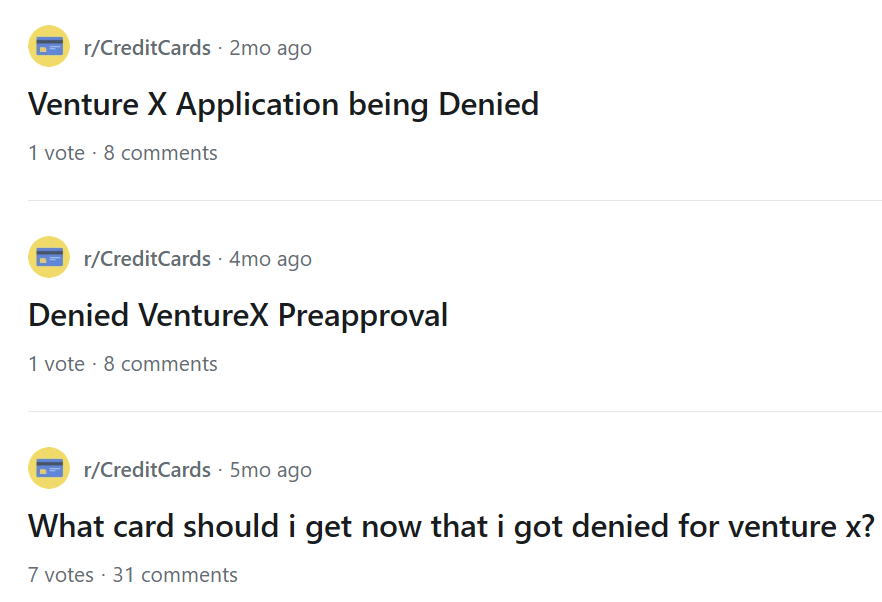
And I mean excellent.
We are talking about people with:
-
100% payment history
-
No collections
-
No charge-offs
-
No late payments
-
Strong FICO scores
-
Low utilization
-
Below Chase 5/24
And Capital One still says no.
That is what makes this card so frustrating.
With some banks, the approval rules are easy to understand.
With Capital One, not so much.
Their approval system can feel random.
Their credit limit increase system can feel even more confusing.
And the Venture X might be one of the best examples of that.
After reviewing Venture X approval and denial data points, one denial reason showed up more than anything else:
Too many revolving accounts.
That one reason was responsible for most of the rejections I reviewed.
Quick Answer
Capital One often denies strong Venture X applicants because they have too many revolving accounts, too many recent inquiries, or too much existing Capital One credit exposure. Even people with high FICO scores, clean payment history, and strong income can get denied if Capital One thinks they already have too many cards or are not likely to make the Venture X their main card. The safest path is to use the Venture X-specific pre-approval tool first, keep recent inquiries low, avoid applying with a crowded credit profile, and consider a product change if Capital One offers one.
Disclosure: This article may contain affiliate links, which means I may earn compensation if you click or apply through certain links.
Helpful resource: Before applying for the Venture X or another card, my Free Credit Card & Loan Pre-Approval Master List can help you find issuer pre-approval pages and avoid guessing before a hard pull.
Why the Venture X Is So Hard to Predict
The Venture X is not a normal approval.
Capital One does not always behave like Chase, Amex, Citi, or Bank of America.
With Capital One, you can see strange outcomes like:
-
High-income applicants getting denied
-
People with 800 scores getting denied
-
People with thin files getting approved
-
Students getting $10,000+ limits
-
People with 12 cards getting rejected
-
People with 3 cards getting approved
-
Pre-approved applicants still getting denied after the full application
That is why this card frustrates people.
Capital One is not just asking:
“Is this person creditworthy?”
They also seem to be asking:
“Do we want this person as a Capital One customer?”
That is a different question.
Capital One Denial Reason #3: Existing Capital One Limits Are Too High
One Venture X denial reason is that your existing Capital One credit limits are already too high.
This means Capital One may not want to give you more total credit across all your Capital One accounts.
Banks call this exposure.
Think of it like this:
If Capital One already gave you $30,000, $40,000, or $50,000 across multiple cards, they may decide they are done extending more credit to you.
Not because your score is bad.
Not because you missed payments.
But because Capital One does not want more risk with one borrower.
Data Point: Denied for Too Much Capital One Credit
One applicant reported being denied for the Venture X because their current Capital One limits were too high.
Their existing Capital One cards were:
-
Capital One Quicksilver: $18,000 limit
-
Capital One Walmart: $10,000 limit
-
Capital One Platinum: $9,000 limit
That is $37,000 in existing Capital One credit.
The denial letter said their credit limits on existing Capital One accounts were considered too high.
That is not a bad-credit denial.
That is an exposure denial.
Capital One had already given that person a lot of credit and did not want to add more.
What to Do If Capital One Says Your Limits Are Too High
If Capital One denies you because your existing limits are too high, you may have a few options.
You can wait.
You can use existing Capital One cards responsibly.
You can see if Capital One eventually offers a product change.
You can also consider whether moving limits or closing accounts makes sense, but be careful.
Closing a no-annual-fee card just to chase a Venture X approval can backfire if it hurts your utilization or account history.
Do not make a desperate move just because Capital One said no.
If Capital One already gave you a lot of exposure, the product change route may be cleaner than a brand-new application.
Capital One Denial Reason #2: Too Many Recent Inquiries
Another major denial reason is too many recent inquiries.
Capital One can be sensitive to hard pulls.
The problem is that there is no clear public rule like:
“You must have fewer than X inquiries in 6 months.”
But the pattern is obvious.
The more recent hard pulls you have, the worse your odds can get.
Capital One may look at inquiries across:
-
6 months
-
12 months
-
24 months
And the recent ones usually matter most.
If you have been applying for cards aggressively, Capital One may see you as a credit seeker.
That is not the profile they want for Venture X.
Why Recent Inquiries Matter So Much
Recent inquiries tell a bank that you are actively looking for credit.
That can mean nothing.
Maybe you are just optimizing rewards.
Maybe you are building a travel setup.
Maybe you are opening business cards.
But from a bank’s point of view, multiple recent inquiries can also mean:
-
You need credit badly
-
You are stretching yourself
-
You may be stacking debt
-
You may not use their card enough
-
You may only want the sign-up bonus
Capital One does not love that.
Especially on a premium travel card like Venture X.
Capital One Denial Reason #1: Too Many Revolving Accounts
This is the big one.
The most common denial reason I saw was:
Too many revolving accounts.
That means Capital One looked at the number of credit card accounts on the report and decided there were too many.
This is where people get mad.
Because someone can have:
-
Great income
-
Great score
-
Low utilization
-
No late payments
-
No collections
-
No bankruptcies
And still get denied because they have too many cards.
Capital One does not always want the person with the thickest rewards-card portfolio.
In fact, that may work against you.
Why “Too Many Revolving Accounts” Hits Credit Card People So Hard
If you are a credit card enthusiast, this is the painful part.
A lot of people in the credit card world have:
-
6 cards
-
10 cards
-
15 cards
-
20+ cards
They have cards for groceries.
Cards for gas.
Cards for travel.
Cards for dining.
Cards for rotating categories.
Cards for business.
Cards for hotel status.
Cards for airline perks.
That might be normal in the credit card community.
But Capital One may look at that and say:
“No thanks.”
Because Capital One wants the Venture X to become a main card.
Not card number 17 in your sock drawer.
Data Point: High Income, Denied for Too Many Revolving Accounts
One applicant had strong income and decent scores.
They reported:
-
Annual income: $215,000
-
Experian: 758
-
Credit Karma score around 760
-
Several open cards
-
Recently around 5/24
Their cards included:
-
Amex Gold
-
Capital One Quicksilver
-
Venmo card
-
Chase Freedom Flex
-
Chase Sapphire Preferred
-
Older Deserve account closed due to inactivity
The denial reason was:
Too many revolving accounts.
That is wild at first glance.
But from Capital One’s point of view, this applicant may have looked like someone who already had multiple cards and was not likely to make Venture X the main card.
Data Point: Denied With Only Four Accounts
Another applicant said they were denied and later received a letter saying they had too many revolving accounts within a year.
They had:
-
Two credit cards
-
Two charge cards
That is only four accounts total.
For most credit card people, four accounts sounds low.
But for Capital One, especially if those accounts are newer, that can still be enough to trigger a denial.
This is why you cannot apply normal credit-card logic to Capital One.
Capital One has its own personality.
And sometimes that personality is annoying.
Data Point: Denied With Six Accounts
Another applicant said their Venture X application was rejected with one reason:
Too many revolving accounts.
They had six accounts.
Again, six accounts is not crazy in the rewards-card world.
But Capital One may not care.
If their model says six revolving accounts is too many for that profile, the application can get denied.
Data Point: Denied With Nine Accounts
Another person said they received the same denial reason when trying to get pre-approved for Venture X.
They had nine revolving accounts.
Their takeaway was simple:
They were not Capital One’s target customer.
That is probably the best way to think about it.
Capital One may not be looking for the person with a massive credit card collection.
They may prefer someone earlier in their credit journey who will actually use the Venture X heavily.
Is There a Hard Limit on Capital One Cards?
A lot of people believe Capital One has a hard limit of two or three personal cards.
That is not always true.
One data point said:
“I have 5 personal Capital One cards: Venture X, Savor, Quicksilver, Walmart, and VentureOne.”
So no, there is not always a strict two-card or three-card limit.
Capital One can allow more.
But that does not mean they will approve everyone for more.
There is a difference between:
“Capital One can approve five cards”
and
“Capital One will approve you for five cards.”
That depends on the profile.
Can You Still Be Denied After Pre-Approval?
Yes.
This is the part nobody likes.
Capital One pre-approval can be helpful, but it is not a final approval.
Capital One says checking pre-approval does not impact your credit score, which is great.
But once you submit the full application, the bank can still deny you.
One applicant checked the Venture X pre-approval page repeatedly and finally got pre-approved.
They then applied.
And got denied.
Their profile included:
-
Equifax: 777
-
TransUnion: 754
-
Experian: 769
-
Utilization around 9% to 10%
-
Annual income: $68,000
-
12 cards
-
Six cards with balances
-
Two Experian inquiries
-
Three TransUnion inquiries
-
One Equifax inquiry
Capital One checked all three bureaus.
This is why pre-approval is useful, but not magic.
Why Capital One May Deny People With Too Many Cards
At first, denying people for too many revolving accounts feels strange.
But there are two reasons it makes sense from Capital One’s side.
1. Risk Management
If someone has a lot of credit cards, the bank may worry that the person has too much available credit already.
Even if utilization is low today, the bank knows balances can rise later.
A person with 15 cards has many places to build debt quickly.
That is risk.
Capital One may not want to add another large premium-card limit on top of that.
2. Profitability
This may be even more important.
Capital One does not want someone who applies, earns the bonus, barely uses the card, and leaves it in a drawer.
They want “top of wallet” behavior.
That means they want the Venture X to become one of your main cards.
If you already have 12 other cards, Capital One may assume the Venture X will not get enough spend to be profitable.
That is why having too many good cards can hurt you.
You may look too optimized.
What Venture X Approvals Usually Have in Common
After reviewing approval data points, the pattern was clear.
Approved applicants often had fewer revolving accounts than denied applicants.
The median number of revolving credit card accounts in the approval data points was around 3.
That is extremely low for credit card enthusiasts.
But it lines up with Capital One’s behavior.
The Venture X seems to favor people who are either:
-
Early in their credit card journey
-
Not heavy churners
-
Low inquiry
-
Low utilization
-
Strong enough income
-
Likely to use the card heavily
This is not always true.
But it is the pattern.
Data Point: Approved With Three Credit Cards
One approved applicant had only three major credit accounts:
-
Chase Sapphire Preferred: $10,600 limit
-
Amex Platinum
-
Navy Federal card: $11,000 limit
That is a simple profile.
Not overloaded.
Not a huge card collection.
Not 20 open revolving accounts.
Capital One likely saw someone who could make Venture X a major card.
Data Point: Approved With a Small Card Lineup
Another approved applicant had:
-
Capital One Quicksilver
-
Hilton Aspire
-
Amex Blue Cash Preferred
-
Authorized user access on a spouse’s Savor card
Again, this is not a massive credit card lineup.
That fits the pattern.
Capital One likes applicants who are not buried in cards.
Why This Is Bad News for Credit Card Enthusiasts
A lot of credit card people already have too many cards for Venture X.
Half of the people in one poll said they already had more than 6 credit cards.
That can be a problem.
Because once your profile is crowded, Capital One may not see you as their ideal customer.
That does not mean you can never get approved.
But it does mean you may need to wait, let inquiries age, let accounts age, and use the pre-approval tool before risking a triple hard pull.
Venture X Minimum Starting Limit
The Venture X is a premium travel card, and because it is a Visa Infinite product, approved applicants typically receive a minimum starting limit of $10,000.
In the approval data points reviewed, a large share of approved applicants received starting limits like:
-
$10,000
-
$20,000
-
$30,000
That is why the card is so attractive.
But that also means Capital One is taking on meaningful exposure when it approves you.
They are not giving you a $500 starter card.
They are usually giving you a five-figure limit.
So the underwriting can be picky.
Capital One Is Approving Some Younger Applicants
One surprising pattern is that Capital One appears willing to approve people earlier in their credit journey.
Some data points included college students and young adults.
That is unusual for a premium travel card.
Most premium travel cards are harder for younger applicants with thin credit profiles.
But Capital One seems willing to take a chance if the profile fits.
Especially if the applicant has:
-
Low revolving account count
-
Low inquiries
-
Clean history
-
Authorized user history
-
Strong enough income for the requested credit
-
A reason to use the card heavily
This is where Capital One gets weird.
A person with 12 cards and a 780 score can get denied.
A younger applicant with fewer accounts can get approved.
Data Point: Approved With Less Than One Year of Credit History
One applicant saw another person get approved for Venture X with less than a year of credit history, so they tested the Venture X-specific pre-approval tool.
They were looking for a Visa card with no foreign transaction fees for study abroad.
The Venture X-specific tool pre-approved them for Venture X, even though the standard Capital One pre-approval tool only showed lower-tier options like Quicksilver for Good Credit and Platinum Secured.
That is important.
The Venture X-specific tool can produce different results than the generic Capital One pre-approval tool.
So if you want Venture X, do not rely only on the general pre-approval page.
Use the card-specific tool if available.
Capital One Can Give High Limits to Lower-Income Applicants
Another surprising pattern:
Capital One has approved some lower-income applicants for high limits.
One applicant reported:
-
Annual income: $55,000
-
Instant approval
-
Credit limit: $25,000
That is a limit equal to about 45% of their annual income.
Another applicant reported:
-
Annual income: $27,000
-
Credit limit: $10,000
That is the minimum Venture X-style high-limit approval range.
This is not normal across all banks.
Many lenders are much more conservative relative to income.
Capital One’s model can be unusual.
Sometimes brutally strict.
Sometimes surprisingly generous.
Why Authorized User Accounts May Help
For younger or lower-income applicants, authorized user accounts may help strengthen the profile.
If an authorized user account is old, clean, and has a high limit, it can improve the look of a credit report.
That does not mean authorized user accounts guarantee approval.
Banks can discount them.
Some banks care more than others.
But in some Capital One data points, authorized user history may have helped build enough profile depth to support approval.
Still, your own primary account history matters more long-term.
Inquiry Counts Among Approved Applicants
Approved Venture X applicants also tended to have low inquiry counts.
In the data points where people shared inquiry numbers, the median was around 2.5 inquiries over 24 months.
That is low.
Especially for credit card people.
Some approved applicants had profiles like:
-
3 Experian inquiries, 0 Equifax, 0 TransUnion before applying
-
Equifax 742 with 1 inquiry
-
TransUnion 734 with 2 inquiries
-
Experian 762 with 1 inquiry
That is the kind of clean inquiry profile Capital One seems to like.
If you have 8 recent inquiries, you are probably not giving Capital One what it wants.
The Four Venture X Approval Paths
Capital One has multiple pathways to Venture X.
1. Direct Application
This is the riskiest path.
You apply directly without pre-approval.
If Capital One denies you, you may still get hard pulls.
Capital One is known for pulling all three bureaus in many cases.
That can hurt.
2. Generic Capital One Pre-Approval
Capital One’s general pre-approval page can show which cards you may qualify for.
This is useful.
But it may not always show Venture X the same way the card-specific tool does.
3. Venture X-Specific Pre-Approval
This is usually the best path if you want Venture X.
The card-specific pre-approval tool is more targeted.
If it gives you Venture X, that is a strong signal.
Still not a guarantee.
But a strong signal.
4. Product Change Page
This is the safest route if Capital One offers it to you.
If your existing Capital One card is eligible to product change to Venture X, you may be able to get the card without a new application.
The downside?
You usually do not get the sign-up bonus.
That is the tradeoff.
Is Product Change Really Guaranteed?
If Capital One shows you a product-change offer inside your account, that is usually the cleanest way to get the card.
You are not applying for a brand-new account.
You are changing an existing Capital One card into a different product.
That can help avoid the approval uncertainty of a new application.
But the offer must be available to you.
You cannot force Capital One to product change your card into Venture X if the option is not there.
Capital One product-change offers are account-specific.
From Denied to Approved: What Actually Works
There is one reliable way to improve your odds after a denial:
Wait.
That sounds boring.
But it works.
Let inquiries age.
Let new accounts age.
Let your profile cool down.
If Capital One denied you for too many recent accounts or too many revolving accounts, applying again next week usually does not fix anything.
The data points show people getting better results after waiting until accounts aged past key points, especially around 24 months.
Data Point: Approved After Waiting
One person said they were approved about 10 months after their last new card.
They had been denied two months earlier when the Venture X first launched.
Between applications, they closed a couple of cards, which may have helped.
I would be careful with closing cards just for an approval.
But the broader lesson is real:
Capital One may respond better after your profile looks less crowded.
Data Point: Pre-Approval Changed After Accounts Aged
Another person said once their Amex Gold and Capital One Quicksilver cards were over 24 months old, the Capital One pre-approval page started showing all cards as approved.
That is a big clue.
Capital One may care a lot about how many recent cards you have inside a 24-month window.
Not just how many cards you have total.
Data Point: Finally Prequalified at 4/24
Another person had been trying to get prequalified for Venture X but kept getting denied for too many revolving accounts.
After they reached 4/24, they finally got prequalified.
That does not mean Capital One follows Chase 5/24.
It does not.
But it does show that recent account count can matter.
Less recent activity can improve your odds.
How I Got the Venture X
I got the Venture X through a product change.
At the time, I was more focused on cash back and did not fully understand the travel value of the Venture X.
But the card kept showing up in my Capital One product change page.
For months, it was just sitting there.
I checked the pre-approval page too, but I was not getting the offer I wanted.
Even with strong credit, Capital One was showing me lower-tier cards.
And I was not about to risk a blind application and take a possible triple hard pull.
So I used the pathway Capital One gave me.
I product changed my Quicksilver into the Venture X.
Did I miss the sign-up bonus?
Yes.
Would some people call that a bad move?
Also yes.
But I got the card without gambling on a full application.
And for me, at that time, that made sense.
Should You Product Change or Apply Directly?
This depends on your profile.
If you are clearly pre-approved for Venture X and your profile is clean, applying directly may be worth it because the sign-up bonus can be valuable.
But if you keep getting denied on pre-approval, have many cards, or do not want to risk multiple hard pulls, product change may be the better route if it is available.
Here is how I would think about it:
Apply directly if:
-
You are Venture X pre-approved
-
You have low inquiries
-
You have fewer revolving accounts
-
You want the bonus
-
You accept the hard-pull risk
Product change if:
-
Capital One offers the upgrade
-
You keep failing pre-approval
-
You have too many cards
-
You do not want new hard pulls
-
You care more about getting the card than getting the bonus
There is no one right answer.
It depends on your risk tolerance.
Who Should Not Apply for Venture X Right Now
Do not apply blindly if:
-
You have lots of recent inquiries
-
You opened several cards recently
-
You already have many revolving accounts
-
You are not pre-approved
-
Your reports are frozen and messy
-
You have several cards with balances
-
You already have high Capital One exposure
-
You are only applying because of the bonus
-
You cannot use the travel benefits
This is not a card to force.
If Capital One does not like your profile right now, wait.
Who Has the Best Odds
You may have better odds if:
-
You have fewer revolving accounts
-
You have low recent inquiries
-
You have low utilization
-
You have clean payment history
-
You have stable income
-
You have a Capital One relationship
-
You are Venture X pre-approved
-
You are early enough in your card journey
-
You can make Venture X a primary card
-
Your credit reports are not overloaded
Capital One seems to want people who will actually use the card.
Not just collect it.
What to Do Before Applying for Venture X
Before applying, I would do this:
-
Check the Venture X-specific pre-approval tool
-
Check the generic Capital One pre-approval tool
-
Check your Capital One product-change offers
-
Lower utilization as much as possible
-
Let recent inquiries age
-
Let new accounts age
-
Avoid applying during an app spree
-
Pay down cards with balances
-
Make sure all credit reports are unfrozen
-
Review all three credit reports for errors
If you are not pre-approved and your profile is crowded, do not force it.
Capital One will still be there later.
Frequently Asked Questions
Why did Capital One deny me for Venture X with excellent credit?
Capital One can deny excellent-credit applicants for reasons like too many revolving accounts, too many recent inquiries, or too much existing Capital One credit exposure. A high score alone does not guarantee approval.
What does “too many revolving accounts” mean?
It means Capital One thinks you have too many credit card or revolving credit accounts on your report. This can happen even if your payment history is perfect and your utilization is low.
Does Capital One pull all three credit bureaus?
Capital One is known for often checking all three major bureaus on credit card applications, though exact pulls can vary. That is why using pre-approval first is important.
Is Capital One Venture X pre-approval guaranteed?
No. Pre-approval is a strong signal, but it is not a final approval. A full application can still be denied after underwriting.
What is the best way to get approved for Venture X?
The best first step is using the Venture X-specific pre-approval page. If you are not pre-approved, wait for inquiries and new accounts to age, lower utilization, and check whether Capital One offers a product change.
Can I product change to Venture X?
Yes, if Capital One gives you that option on your existing account. Product-change offers are account-specific. The downside is that you generally will not receive the new-card sign-up bonus.
Conclusion
The Venture X is a strange card.
Capital One will deny people with excellent credit and then approve people with thinner files, fewer cards, lower income, or shorter histories.
That feels backward.
But once you look at the data points, the pattern makes more sense.
Capital One does not just want good credit.
They want the right kind of customer.
They seem to prefer people with fewer revolving accounts, fewer recent inquiries, low utilization, and a real chance of making Venture X a main card.
If you already have a giant card collection, the Venture X may not be built for your profile right now.
That does not mean you can never get it.
It means you need to be more strategic.
Use the pre-approval tool.
Watch your inquiries.
Let accounts age.
Check the product-change page.
And do not risk a blind application unless your profile actually matches what Capital One seems to want.
Because with Capital One, a high credit score is not enough.
The full profile has to make sense.