
Capital One Product Upgrade Link: How to Check for Hidden Offers
Jun 26, 2026
Some Capital One cardholders are finding upgrade offers that do not always show up inside the normal account dashboard.
And no, this is not really a “hack” in the illegal sense.
It is more like forcing Capital One’s product upgrade page to load while you are already logged into your own account.
That matters because some people check their account for months and see nothing.
No upgrade options.
No useful offers.
No movement.
Then they manually open the product upgrade page and suddenly see an offer sitting there.
For Capital One cardholders, this is worth knowing about.
Especially if you are trying to move from a weaker card into a better long-term card without opening a brand-new account.
Disclosure: This article may contain affiliate links, which means I may earn compensation if you click or apply through certain links.
Quick Answer
Some Capital One cardholders are checking for product upgrade offers by logging into their account, opening a card account page, and manually adding /productupgrade to the end of the URL. Others use a direct Capital One product upgrade link. Product upgrades are different from new card applications because they usually keep the existing account open, typically do not create a new credit card account, and usually do not require a hard pull. But upgrade offers are targeted, so not every cardholder will see the same options.
How the Capital One Product Upgrade Trick Works
Here is what people are doing.
They log into their Capital One account.
Then they click into one of their credit cards.
That brings them to the page where they can see things like:
-
Balance
-
Transactions
-
Rewards
-
Payments
-
Account details
Then they go up to the URL and manually add this to the end:
/productupgrade
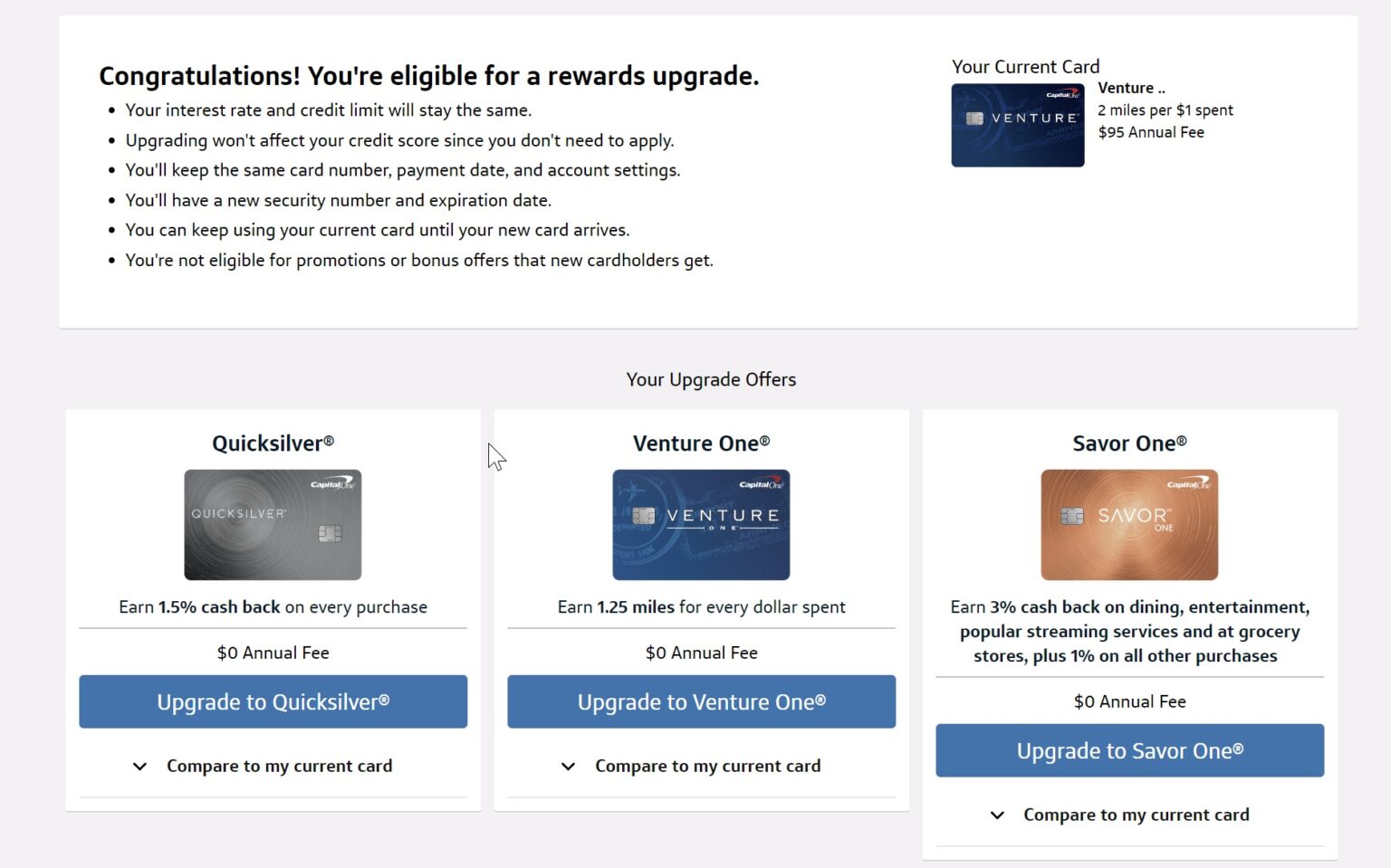
That is it.
No special software.
No shady backdoor.
Just a manual attempt to load the product upgrade page for that card.
Some people are also using the direct Capital One product upgrade link instead.
In my testing, both methods took me to the same place and showed me the same offers.
But the reason people are talking about this is because some cardholders say they saw no upgrade offers in the app, no useful options in the normal account area, and even got told by customer service that no offers were available.
Then they loaded the upgrade page directly and saw an offer.
That is why people are paying attention.
Helpful resource: I keep useful links like this inside my Free Credit Card & Loan Pre-Approval Master List, along with cards that may let you check your odds before a hard pull: https://courses.calbartoncashback.com/pre-approval-master-list-Blog
What Kind of Capital One Upgrade Offers Are People Seeing?
The upgrade offers can vary a lot.
Some cardholders have reported seeing upgrades like:
-
Capital One Platinum to Savor
-
QuicksilverOne to Quicksilver
-
Quicksilver to Venture
-
Quicksilver to Venture X
-
Venture to Venture X
-
Other card-family upgrade options
The most interesting part is that these offers may appear even when other areas of the account show nothing useful.
That does not mean everyone will see an upgrade.
And it definitely does not mean everyone will see a premium card like Venture X.
But if you already have a Capital One card, checking the upgrade page can be worth a few seconds.
The worst-case scenario is usually that no upgrade offer is available.
Why This Works for Some People and Not Others
This is where a lot of people get frustrated.
They try it once, see nothing, and assume the whole thing is fake.
But Capital One has different systems for different decisions.
A new card application is one thing.
A product upgrade is something else.
When you apply for a brand-new Capital One card, you may deal with:
-
Full underwriting
-
A new application
-
A hard pull in many cases
-
Approval or denial
-
New account reporting
-
A separate credit line
But when you are looking at a product upgrade, the question is different.
Capital One is not necessarily asking:
“Should we approve this person for a brand-new account?”
The question is more like:
“Do we want to move this existing customer into a different product?”
That is a different type of decision.
And that is why some cardholders can sometimes upgrade into cards they might not be approved for directly as a brand-new application.
Product Upgrade vs New Credit Card Application
This distinction matters.
A product upgrade usually keeps the existing account alive.
That means you are not opening a brand-new credit card account the same way you would with a new application.
You are changing the product attached to your existing account.
That can be useful because it may help you:
-
Avoid opening a new account
-
Avoid a hard inquiry in many cases
-
Keep your account history
-
Preserve your existing credit line
-
Move into better rewards
-
Drop an annual fee
-
Get more use out of an old card
That is why product changes are so powerful.
You may have an old card that no longer fits your spending.
Instead of closing it or applying for something new, you may be able to turn it into something more useful.
Why Capital One Product Changes Can Be So Valuable
Capital One is known for being a little weird with underwriting.
Some people get approved for huge limits.
Other people get stuck with low-limit cards for years.
Some accounts seem to grow.
Others feel completely bucketed.
That is why product changes matter so much with Capital One.
Because sometimes the best move is not applying for another card.
Sometimes the better move is improving the card you already have.
For example, if you have a QuicksilverOne with an annual fee, upgrading to a no-annual-fee Quicksilver could be a major improvement.
If you have an old Quicksilver that you barely use, upgrading into a Venture or Venture X could make the account much more useful.
If you have a card that earns weak rewards, moving into a better rewards structure can make the account worth keeping.
The point is not to chase an upgrade just because it appears.
The point is to optimize your existing account.
My Own Capital One Upgrade Data Point
I have personally used a Capital One product change before.
A few years ago, I had a Quicksilver card sitting around a $16,000 limit.
I used a product change to move that account into a Venture X.
And not long after that, I started getting back-to-back credit limit increases.
Fast forward a couple years, and that same account is now sitting at $40,000.
That does not mean everyone will get the same result.
It does not mean upgrading causes credit limit increases.
And it does not mean Capital One will treat every profile the same way.
But it does show why I pay attention to product upgrade options.
Sometimes the account you already have can become much more valuable over time.
Why You Should Check More Than Once
If you have a Capital One card, I would not check this one time and then forget about it forever.
Upgrade offers can change.
You might see nothing today.
Then a few months later, something appears.
That can happen because Capital One may be looking at things like:
-
Account age
-
Payment history
-
Recent usage
-
Credit profile changes
-
Internal risk models
-
Card eligibility
-
Product availability
-
Account behavior
-
Profitability signals
Nobody outside Capital One knows the full formula.
But we do know offers can change over time.
So if nothing appears today, that does not automatically mean nothing will ever appear.
What Makes a Capital One Upgrade Worth It?
Do not get excited just because something shows up.
An upgrade is only worth it if it improves your position.
Good upgrade reasons may include:
-
Dropping an annual fee
-
Moving into better rewards
-
Getting a card that fits your spending better
-
Making an old card useful again
-
Preserving account history instead of closing the card
-
Avoiding a new hard inquiry
-
Avoiding a brand-new account
-
Moving into a better long-term card family
Bad upgrade reasons include:
-
Upgrading just because the offer appeared
-
Moving into a card with a higher annual fee you will not use
-
Giving up a card that fits your spending better
-
Assuming you will get a welcome bonus
-
Thinking the upgrade guarantees credit limit increases
That last one is important.
A product upgrade is not the same as applying for a brand-new card.
So you usually should not expect a new cardholder welcome bonus.
That can be one of the biggest tradeoffs.
The Welcome Bonus Tradeoff
This is the main reason some people should not upgrade.
If you apply for a brand-new card and get approved, you may be eligible for a welcome bonus.
But with a product upgrade, you are usually changing an existing account.
That means you may not get a welcome bonus.
So the decision comes down to what matters more.
Do you want to preserve the existing account and avoid a new application?
Or do you want to apply for a new card and potentially earn a welcome bonus?
There is no one-size-fits-all answer.
If you are under strict approval rules, trying to protect your credit profile, or trying to avoid hard inquiries, a product upgrade may make more sense.
If you are chasing a major welcome bonus and can qualify for the card directly, a new application may be better.
How I Would Use the Capital One Product Upgrade Page
If I had a Capital One card, I would check the upgrade page occasionally.
Not obsessively.
Not every day.
But maybe every few months.
And when an offer appears, I would ask:
-
Does this card fit my spending?
-
Does it remove an annual fee?
-
Does it improve my rewards?
-
Does it make this account more useful?
-
Am I giving up a better product?
-
Would I be better off applying separately for a welcome bonus?
-
Is this upgrade worth it without a bonus?
That is how I would look at it.
The upgrade page is not magic.
It is just another tool.
But if you use it correctly, it can help you squeeze more value out of an account you already have.
Frequently Asked Questions
How do I check Capital One product upgrade offers?
Some cardholders check by logging into Capital One, opening their card account, and manually adding /productupgrade to the end of the URL. Others use the direct Capital One product upgrade link. Either way, you should only check offers while logged into your own account.
Does a Capital One product upgrade require a hard pull?
A product change typically does not require a hard inquiry because it usually does not involve opening a brand-new credit card account. But you should always review the terms shown on the upgrade page before accepting anything.
Can I upgrade from Quicksilver to Venture X?
Some cardholders have reported seeing Venture X as a product upgrade option from existing Capital One cards, including Quicksilver. But offers are targeted, so not everyone will see the same options.
Will I get a welcome bonus if I upgrade?
Usually, product upgrades do not include the same welcome bonus you might get from applying for a brand-new card. That is one of the biggest tradeoffs to consider before accepting an upgrade.
Why does Capital One show no upgrade offers?
Capital One upgrade offers are targeted and can depend on your account, card type, account age, usage, payment history, credit profile, and internal eligibility rules. If you see no offer today, that does not mean you will never see one.
Is a product upgrade better than applying for a new card?
It depends on your goal. A product upgrade can help preserve an existing account and usually avoids a new application, but a new card application may offer a welcome bonus and a separate credit line.
Final Thoughts
The Capital One product upgrade page is worth checking if you already have a Capital One card.
It is not guaranteed to show anything.
And it is not some secret approval button.
But it can reveal offers that some cardholders may not see in the normal app experience.
That makes it useful.
Especially for people with older Capital One cards that no longer fit their spending.
If you can drop an annual fee, move into better rewards, or turn a forgotten card into something useful, that can be a real win.
Just remember the tradeoff.
You usually are not getting a welcome bonus.
You are not opening a new account.
And an upgrade does not guarantee a higher credit limit.
This is about optimizing what you already have.
And with Capital One, that can sometimes be the smartest move.