
Why a 660 Credit Score Can Change Your Personal Loan Rate
Jun 25, 2026
One of the biggest reasons people overpay on personal loans may have nothing to do with their job, income, or ability to repay the debt.
It may come down to whether their credit score is sitting above or below one important line:
660.
That sounds ridiculous, but this is exactly why personal loan shopping can be so frustrating.
Two people can look almost identical on paper, but if one person is just barely above a lender’s pricing cutoff and the other person is barely below it, the interest rate difference can be massive.
And the most frustrating part?
Many borrowers do not even realize this is happening.
Disclosure: This article may contain affiliate links, which means I may earn compensation if you click or apply through certain links.
Quick Answer
A credit score around 660 can matter a lot when shopping for a personal loan because some lenders appear to price borrowers in large credit-score groups instead of treating every individual score differently. Research on fintech personal loans found that borrowers below 660 could face significantly higher rates than similar borrowers above 660. That is why a small credit score improvement, especially if you are sitting in the 640–659 range, may potentially save you hundreds or even thousands of dollars in interest.
The Big Promise Fintech Lenders Made
For years, a lot of people bought into the idea that fintech lenders were different.
They were not supposed to act like old-school banks.
Instead of relying too heavily on a three-digit credit score, the pitch was that fintech lenders could use:
-
Artificial intelligence
-
Machine learning
-
Bank account data
-
Employment information
-
Cash-flow patterns
-
Alternative underwriting data
At least, that was the marketing.
The idea sounded good.
Instead of being judged mostly by your credit score, lenders would supposedly build a more complete picture of your financial life.
But research on fintech-issued personal loans showed something very different.
When it came time to price the loan, traditional credit scores still appeared to do a lot of the heavy lifting.
And one of the biggest dividing lines was sitting around a 660 credit score.
Why One Point Can Matter So Much
Here is where things get interesting.
Researchers looked at borrowers near the 660 line.
Not people with wildly different financial situations.
Not one borrower with terrible credit and another borrower with perfect credit.
People who looked very similar.
The difference was that one borrower could be just below 660, while another borrower could be just above it.
And that small difference could translate into a much higher interest rate.
That is the part people need to understand.
Most borrowers assume lenders price every exact credit score individually.
So they imagine someone with a 659 score should be priced almost the same as someone with a 660 score.
But that is not always how lending works.
In many cases, lenders are not treating your score like a perfect sliding scale.
They are sorting people into groups.
Personal Loan Pricing Can Work Like Airplane Boarding Groups
Think about boarding an airplane.
The airline usually does not call every passenger one seat at a time.
They do not say:
“Now boarding seat 18A.”
“Now boarding seat 18B.”
“Now boarding seat 18C.”
Instead, they call groups.
Group 1.
Group 2.
Group 3.
Group 4.
If you are in Group 3, you board when Group 3 boards.
It does not really matter whether you are the first person in Group 3 or the last person in Group 3.
A lot of loan pricing can work in a similar way.
You may think your exact score is being evaluated down to the point.
But in reality, your score may place you into a broader pricing group.
That means someone with a 661 may be treated closer to someone with a 690 than someone with a 659.
And once you cross into a different group, the pricing can change fast.
The Invisible Tax Below 660
This is what I’d call an invisible tax.
Because most people never see the pricing model.
They just see the offer.
They apply for a personal loan, get quoted a rate, and assume that is simply what they qualify for.
But if their score is sitting below a key cutoff, they may be paying more than someone else with a very similar risk profile.
On a smaller loan, that could mean hundreds of dollars in extra interest.
On a larger debt consolidation loan, it could mean thousands.
And that is where this gets serious.
Because if someone is using a personal loan to pay off credit card debt, the whole point is usually to save money, simplify payments, or get a clearer payoff plan.
But if the rate is too high, the loan may not help nearly as much as the borrower thinks.
In some cases, it can make the debt problem worse.
Why the Rate Gap May Not Be All About Risk
The obvious defense from lenders would be:
“Well, borrowers below 660 are riskier.”
And yes, credit scores can reflect risk.
That is not the issue.
The issue is whether the rate difference is fully justified by the actual risk difference.
The research suggests the answer may not be that simple.
The study looked at whether borrowers below the 660 line were secretly much riskier than similar borrowers above it.
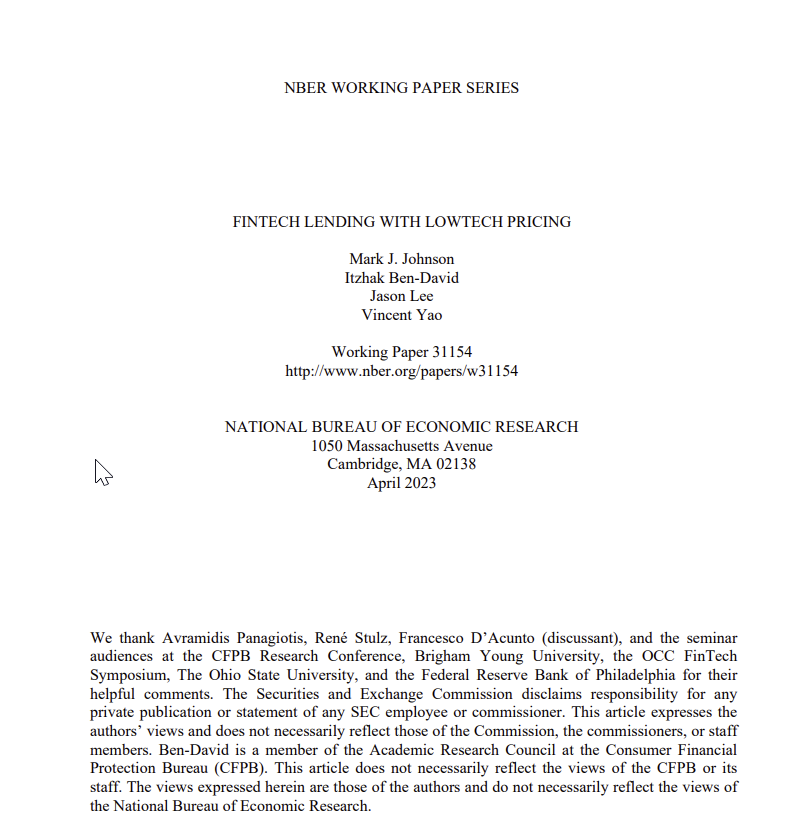
The evidence did not fully support the idea that the pricing gap was driven only by risk.
Even during stressful periods, the pricing gap remained.
That suggests a lot of the difference may come from the category the borrower is placed into, not just a careful one-by-one review of their full financial picture.
That is the part borrowers need to understand.
Sometimes the line matters more than you think.
Why This Keeps Happening
This explains a lot of what people see in the real world.
One person gets quoted what feels like an outrageous personal loan rate.
Someone else gets approved at a rate that seems almost impossible.
And both borrowers may be closer than you think.
The difference may be that one person landed on the wrong side of a lender’s pricing line.
The study also found that lenders may compete more aggressively for borrowers above 660 because those borrowers often have more options.
They may be able to get quotes from:
-
Banks
-
Credit unions
-
Online lenders
-
Existing financial institutions
-
Balance transfer credit cards
-
Other lower-cost financing options
But below 660, competition can start drying up.
And when competition dries up, borrowers can lose leverage.
That is when rates can stay high.
What To Do If Your Credit Score Is Below 660
If your score is below 660, the first thing to do is not panic.
But you should pay attention.
Especially if you are in the 640 to 659 range.
That range may be one of the most important zones in your credit journey if you are shopping for a personal loan.
A small improvement could potentially have a big impact.
I have seen people gain 10, 25, or even 50 points simply by paying down credit card balances.
That does not mean everyone will see the same result.
But if your credit utilization is high, paying down revolving balances can sometimes move your score faster than people expect.
And if that move pushes you over a lender’s pricing line, the savings could be much bigger than the score change looks on paper.
Pay Attention to Credit Card Utilization
If you are trying to improve your score before applying for a personal loan, credit card utilization is one of the first places I would look.
Utilization is basically how much of your available credit you are using.
For example, if you have a $10,000 total credit limit and you are carrying $7,000 in balances, your utilization is high.
That can hurt your score.
If you pay those balances down, your score may improve.
And if you are close to a key personal loan pricing threshold, that improvement may matter a lot.
This is why timing matters.
Sometimes applying today versus applying after paying down balances and waiting for the new balances to report can change the type of offer you see.
Never Accept the First Personal Loan Offer
The second thing I would do is shop aggressively.
Do not accept the first personal loan offer just because it is the first one you received.
That is exactly how people overpay.
One lender may quote you a high rate.
Another lender may look at the same profile and quote something much better.
That difference could be worth hundreds or thousands of dollars.
The first offer should be treated like a starting point.
Not the finish line.
Helpful resource: If you are checking personal loan options, SoFi Personal Loans may be worth reviewing because you can check your rate without impacting your credit score: https://calbarton.link/SoFi-Loan
Why Pre-Approval Tools Matter
This is one reason I like pre-approval tools.
A good pre-approval tool can let you compare potential offers before committing to a hard inquiry.
That matters because every lender has its own pricing model.
Even if two lenders look at the same borrower, they may not price the loan the same way.
One may be more competitive for people with excellent credit.
Another may be better for borrowers with fair credit.
Another may be more flexible for debt consolidation.
Another may be stricter about income, employment, or existing debt.
You do not know until you compare.
And if you are close to a score cutoff, comparing offers becomes even more important.
Do Not Forget About Credit Unions
The third thing I would do is check credit unions.
Do not automatically assume a fintech lender is your best option.
A lot of people overlook credit unions completely.
And sometimes that is a mistake.
Credit unions may offer:
-
Lower rates
-
More flexible underwriting
-
Relationship-based lending
-
Smaller personal loans
-
Better terms for existing members
-
More human review than some online lenders
That does not mean every credit union will beat every fintech lender.
But if you are considering a personal loan, I would want at least one credit union quote sitting next to every online lender quote before making a decision.
Especially if you already have a relationship with that credit union.
Sometimes relationship banking matters.
And sometimes it matters more than people think.
When a Personal Loan Actually Makes Sense
A personal loan can be useful when it helps you lower your interest rate, simplify your payments, and create a clear payoff timeline.
But the rate matters.
A debt consolidation loan is not automatically a good deal just because the monthly payment looks lower.
A lower payment can sometimes come from stretching the loan over a longer term.
That may reduce the monthly pressure, but it can also keep you in debt longer and increase the total interest you pay.
So before accepting a personal loan, look at:
-
The interest rate
-
The monthly payment
-
The loan term
-
The origination fee, if any
-
The total interest cost
-
Whether you will keep using the credit cards after consolidating
-
Whether the loan actually speeds up your payoff
The real question is not:
“Can I get approved?”
The real question is:
“Does this loan actually improve my situation?”
Frequently Asked Questions
Why does a 660 credit score matter for personal loans?
A 660 credit score can matter because some lenders may use broad credit score groups when pricing personal loans. If 660 is a key line in a lender’s model, being slightly above or below that line could affect the rate you are offered.
Can one credit score point really change my loan rate?
It can, depending on the lender’s pricing model. If one score places you below a lender’s cutoff and another score places you above it, the pricing difference can be much larger than people expect.
Should I wait to apply if my score is between 640 and 659?
It may be worth considering, especially if you can improve your score by paying down credit card balances or correcting errors. If you are close to 660, even a small score increase may potentially help you get better offers.
Are fintech lenders always cheaper than banks or credit unions?
No. Fintech lenders can be convenient, but that does not automatically make them cheaper. Banks, credit unions, and online lenders can all price the same borrower differently, which is why shopping around matters.
Do personal loan pre-approvals hurt your credit?
Many personal loan pre-approval tools use a soft pull, which does not affect your credit score. But you should always confirm before submitting your information because a full application may require a hard inquiry.
Is a debt consolidation loan always a good idea?
No. A debt consolidation loan only helps if the rate, fees, term, and total cost make sense. If the loan lowers your payment but stretches the debt out too long, you may not save as much as you think.
Final Thoughts
The biggest lesson here is simple:
Your exact credit score may not matter as much as the group your score falls into.
And if one of those groups starts around 660, being just below that line could cost you real money.
That is why you should know your score before applying, pay attention to your utilization, shop multiple lenders, and compare credit union options before accepting a personal loan.
Do not let one lender’s offer convince you that it is the best you can do.
The first offer is just one data point.
Your job is to find out whether a better one exists.