
0% APR Business Credit Cards for New LLCs: 4 Banks to Watch
Jun 26, 2026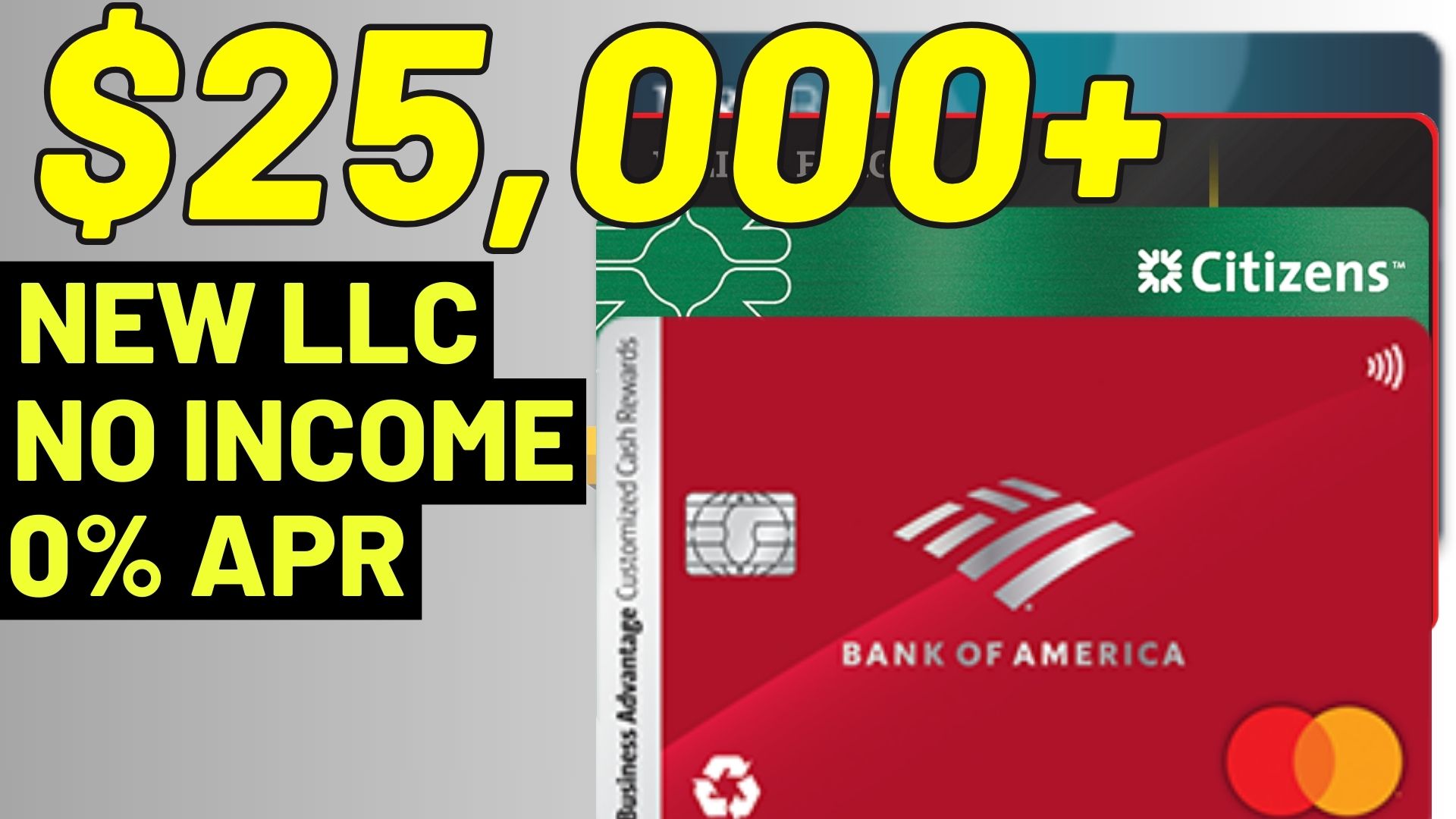
If you just formed a new LLC, you may think business funding is out of reach.
A lot of business owners assume they need:
-
12 months of bank statements
-
2 years of tax returns
-
Strong business revenue
-
Perfect business credit
-
A long relationship with the bank
But that is not always true.
Some banks may approve new or newer businesses for business credit cards with low documentation, strong starting limits, and 0% intro APR offers.
And if you understand how to sequence applications, spread out credit pulls, and use banking relationships properly, these cards can become a serious business funding tool.
I have seen data points with approvals around $20,000, $25,000, $30,000, $40,000, and even larger funding sequences that approach $200,000 in business credit.
That does not mean everyone will get approved.
But it does show what is possible when your personal credit, business profile, and application strategy are lined up correctly.
Disclosure: This article may contain affiliate links, which means I may earn compensation if you click or apply through certain links.
Quick Answer
Some new LLCs may be able to get approved for 0% APR business credit cards with low or no income documentation, especially when the owner has solid personal credit, low utilization, clean reports, and a banking relationship. Banks like Citizens, M&T, Bank of America, Wells Fargo, and Chase have shown strong business credit card approval data points, but requirements vary by bank, product, state, relationship, and credit profile. The best results usually come from preparing your personal credit first, building some business credit reporting, and applying in the right order.
Why 0% APR Business Credit Cards Matter
A 0% APR business credit card can be one of the easiest ways to fund a business without taking out a traditional loan.
Used correctly, it can help you pay for:
-
Inventory
-
Marketing
-
Equipment
-
Software
-
Contractors
-
Payroll gaps
-
Supplies
-
Business travel
-
Startup expenses
The biggest advantage is that you may be able to carry a balance during the intro period without paying interest.
That gives your business time to turn the money into revenue before interest kicks in.
But this only works if you have a plan.
A 0% APR card is not free money.
It is borrowed money with a temporary interest break.
Once the intro period ends, the regular APR can be much higher. So you need to know how the balance will be paid down before the promotional period expires.
Helpful resource: If you want a deeper list of 0% APR business credit card options for funding and credit stacking, my 0% APR Business Credit Card Database can help you compare cards, banks, and funding opportunities: https://courses.calbartoncashback.com/0-apr-business-cards-1
The Goal: Separate Business Funding From Personal Credit
A lot of new business owners fund everything with personal cards.
At first, that may feel normal.
But eventually, it gets risky.
Every time the business needs money, your personal utilization spikes.
Then your personal score drops.
Then your debt-to-income ratio looks worse.
Then future approvals get harder.
That is why business credit cards can be so powerful.
Even when they require a personal guarantee, many business cards do not report balances to your personal credit as long as the account stays in good standing.
That can help you use credit for business expenses without your personal credit report looking maxed out every month.
This is one of the biggest reasons business owners should learn how business credit card approvals work.
Bank #1: Citizens Bank Business Credit Cards
Citizens Bank showed one of the strongest data points in the original research.
One business owner reported being approved for a $25,000 line through the Citizens Business Everyday Points credit card.
The application timeline looked like this:
-
Applied on Friday
-
Submitted bank statements
-
Received approval by Tuesday afternoon
-
Final approval: $25,000
That is a strong starting limit.
Especially considering the reported personal credit scores were not perfect.
The data point included:
-
TransUnion: 693
-
Experian: 702
-
Equifax: 692
-
Overall personal credit card utilization around 42%
-
D&B score of 80 with 6 tradelines reporting
-
Experian business score of 88 with 2 active tradelines reporting
-
Equifax business score around 380
That profile was not perfect.
The personal utilization was higher than I would like to see.
But the approval still came through.
That tells me Citizens may be more flexible than some banks when the overall file makes sense.
Citizens May Ask for Bank Statements
In this data point, Citizens requested three months of bank statements.
The applicant provided six months to give a better overall picture.
That is not completely no-doc.
But it is still manageable.
Three months of bank statements is much easier than being asked for two years of tax returns and a full financial package.
For a newer LLC with a few months of real activity, this type of request may still be doable.
That is why I would not automatically write off a bank just because it asks for bank statements.
The key is whether the documentation request is reasonable.
Business Credit Still Helps
One important lesson from the Citizens data point is that the business had some tradelines reporting.
Not a massive business credit profile.
But something.
That matters.
A lot of business owners wait until they need funding to start thinking about business credit.
That is backwards.
Ideally, you want at least a few business tradelines reporting before you start applying for bigger business credit cards.
You do not necessarily need a thick business credit file to get approved.
But having something reporting can help your business look more real.
Helpful resource: I use Nav to monitor business credit and help track business credit data across multiple bureaus. If you are trying to build or monitor your business credit profile, you can check out Nav here: https://offers.calbartoncashback.com/NAV
Citizens Relationship Data Point: $40,000+ Approval
Another Citizens data point was even stronger.
A business owner reported closing an Everyday Points card and applying for the Citizens Business Platinum card.
They expected something around $20,000 to $25,000.
Instead, they were approved for more than $40,000.
They also reported:
-
No proof of income
-
No bank statements
-
Soft pull on Equifax
-
Personal credit over 800
-
Strong business credit profile
-
12 months of 0% APR on the Platinum card
That is a very different profile from the first data point.
This person had stronger credit and an existing Citizens relationship.
That likely mattered.
The lesson is simple:
A prior banking relationship can change the approval experience.
With some banks, having deposits, history, and existing accounts can make the process smoother.
Sometimes it may even lead to softer documentation requirements or soft-pull offers.
Citizens Is Regional
The downside with Citizens is access.
Citizens is a regional bank.
That means it may work best if you are located near a branch or inside its footprint.
The states listed in the research included:
-
Connecticut
-
Delaware
-
Florida
-
Maryland
-
Massachusetts
-
Michigan
-
New Hampshire
-
New Jersey
-
New York
-
Ohio
-
Pennsylvania
-
Rhode Island
-
Vermont
-
Virginia
-
Washington, DC
If you are outside the footprint, this may be harder.
That is one of the annoying parts about regional banks.
They can have strong business credit products, but access is not always nationwide.
Bank #2: M&T Bank Business Credit Card
M&T Bank showed up inside a much larger funding sequence.
This data point involved someone in Vermont with extremely strong personal credit:
-
TransUnion: 850
-
Experian: 837
-
Equifax: 810
-
Inquiries: 0
They started a business credit sequence and reported nearly $200,000 in approvals.
One of those approvals was:
M&T Bank Business Card: $30,000
The reported bureau pull was Experian.
That is a big approval.
But the profile was also extremely clean.
This is not the same as someone applying with high utilization, recent inquiries, and thin credit.
This person had the kind of profile banks love.
The $200,000 Business Credit Sequence
The full sequence included several business card approvals and credit products.
Reported approvals included:
-
M&T Bank Business Card: $30,000
-
Citizens Bank Business Card: $50,000
-
Chase Ink Business Unlimited: $20,000
-
Amex Blue Business Plus: $2,000
-
Union Bank TCM Card: $30,000
-
Elan Bank of New Hampshire: $3,000
-
Elan Northfield Savings Bank: $3,000
-
Community Bank Business Edition: $13,500
-
GM Card: $23,500
-
Bank of America Unlimited Cash: $9,000
-
TD Bank: $15,000
-
Citizens Bank Line of Credit: $50,000
-
Amex Gold Card with reported $50,000 spending power
The total approvals were around $199,000 before counting the Amex Gold and line of credit in the same way.
This is what a business credit funding sequence can look like when executed properly.
But most people should not copy this blindly.
A funding sequence like this requires planning.
Why Bureau Strategy Matters
One reason this sequence worked is that the applicant had room across all three personal credit bureaus.
They had zero recent inquiries.
That gave them flexibility.
The reported pulls were spread across:
-
Experian
-
Equifax
-
TransUnion
That matters because if you stack too many applications on one bureau, banks may start seeing you as credit-seeking before the sequence is complete.
In a perfect world, you would spread applications across the bureaus instead of hammering one report over and over.
That might mean applying for some banks that pull Experian, some that pull Equifax, and some that pull TransUnion.
You will not always know for sure which bureau a bank will pull.
But tracking data points can help you build a smarter sequence.
Why a Fresh Credit Report Matters
The person in the $200,000 sequence had zero inquiries in the last two years.
That is a huge advantage.
If you want to attempt a major business credit card funding play, you want your reports as clean as possible.
Ideally, you want:
-
Low utilization
-
Few or no recent inquiries
-
Few or no new accounts
-
Strong payment history
-
Healthy personal scores
-
No recent derogatory marks
-
Existing business banking relationships
-
Some business credit reporting
A clean report gives you room to move.
A messy report limits your options fast.
Bank #3: Bank of America Business Credit Cards
Bank of America also showed strong data points.
One business owner reported a $25,000 approval for a Bank of America Business Advantage card.
They applied as an LLC.
The reported pull was TransUnion.
The approval was not instant.
They had to complete additional verification around identity, address, and personal information.
But they reported that no proof of income was required.
That is what makes the data point interesting.
A $25,000 business card approval with identity verification but no formal income documents is exactly the kind of approval newer business owners pay attention to.
Why Bank of America Pulling TransUnion Matters
A lot of large banks tend to pull Experian for business credit applications.
So when Bank of America pulls TransUnion in a data point, that matters.
If you are building a business credit application sequence, TransUnion pulls can be useful because they may help you avoid overloading Experian.
That does not mean Bank of America will always pull TransUnion for everyone.
Bureau pulls can vary by state, product, profile, and application path.
But from a sequencing perspective, Bank of America is worth watching.
Bank of America Relationship Data Point: $20,000 Approval
Another Bank of America data point involved a $20,000 approval for the Business Cash Rewards card.
The person had:
-
A personal checking relationship for a few years
-
Two personal Bank of America credit cards
-
A new business checking account opened about a week earlier
-
Preferred Rewards Platinum status
-
TransUnion score around 759
-
8 inquiries
-
Recently returned to 5/24
They originally saw a lower in-branch bonus offer.
Then they found an online offer with a larger bonus and applied through that path.
The result was an instant $20,000 approval.
That is a big lesson.
Sometimes the best offer is not the one shown in branch.
Banks may have different online landing pages, different promotions, and different signup bonuses for the same card.
If you apply through the wrong path, you might leave money on the table.
Watch Your 5/24 Timing
The Bank of America data point also included a useful lesson about 5/24 timing.
The person waited an extra month after accounts reached the two-year mark because another issuer still counted them as having too many new cards.
That matters.
A lot of people think they are under 5/24 the second they enter the 24th month.
But in practice, you want to be careful.
Many issuers may still count accounts until the full 24 months have passed.
If you are trying to time business card applications, waiting until month 25 can be safer.
That extra month can be the difference between an approval and a frustrating denial.
Bank #4: Wells Fargo Business Cards
Wells Fargo had one of the most interesting soft-pull business card data points.
A business owner opened a Wells Fargo business account in person.
During the process, the banker told them they were preapproved for a business credit card.
The reported result was:
-
Wells Fargo Business Platinum approval
-
$20,000 starting limit
-
Personal Experian soft pull during business account opening
-
No Experian hard pull
-
FICO 9 around 832
-
Existing personal relationship with Wells Fargo
That is the kind of data point I pay attention to.
Because it shows how in-branch relationship banking can sometimes unlock offers that may not show up the same way online.
Ask About Pre-Approvals in Branch
If you are opening a business bank account in person, do not just open the account and leave.
Ask the banker if there are any business credit card pre-approvals or business lending offers available.
Sometimes the system may show offers during account opening.
That does not guarantee approval.
But if the bank is already soft-pulling your profile as part of the relationship, you may be able to see offers without immediately taking a hard pull.
The key is to ask clearly.
You can say something like:
“Before I submit any application, can you check whether I have any pre-approved business credit card offers available?”
That small question can make a big difference.
Wells Fargo Signify Business Cash Card
The older Wells Fargo Business Platinum card may not be the main card to focus on anymore.
Wells Fargo now has the Signify Business Cash Card.
That card is interesting because it offers:
-
0% intro APR for 12 months from account opening
-
Unlimited 2% cash rewards
-
No annual fee
-
A $500 cash rewards bonus after meeting the spending requirement
That makes it one of the more interesting newer business cards to watch.
Especially for business owners who want simple cash back and a 0% APR window.
Chase Ink Business Unlimited as a Nationwide Option
Regional banks can be powerful.
But they can also be annoying.
Because what if you do not live in the right state?
That is where a card like the Chase Ink Business Unlimited becomes important.
The Chase Ink Business Unlimited is available nationally and can be a strong business credit card for newer businesses.
It offers:
-
0% intro APR for 12 months on purchases
-
No annual fee
-
Unlimited 1.5% cash back
-
A welcome bonus after meeting the spending requirement
-
The ability to apply as a sole proprietor
This is one of the reasons I still think the Ink Business Unlimited is one of the most useful business cards out there.
It is simple.
It is flexible.
And it can work for many different types of businesses.
In my own case, Chase approved my business, Barton Media LLC, for a $21,000 starting limit.
That was one of my strongest business credit card approvals for a long time.
What to Do Before Applying for Business Credit Cards
Before you start applying for business credit cards, get your profile ready.
Do not just start submitting applications randomly.
That is how people waste hard inquiries.
I would focus on:
-
Lowering personal utilization
-
Cleaning up recent inquiries
-
Waiting until new accounts age
-
Opening business checking accounts
-
Building some business credit tradelines
-
Monitoring business credit reports
-
Checking pre-approvals where available
-
Mapping out which banks pull which bureaus
-
Applying in a smart sequence
If your personal credit card utilization is 42%, like one of the Citizens data points, approval is still possible.
But that does not mean it is ideal.
For stronger starting limits, I would rather see utilization closer to 10% or below before applying.
That can make a major difference in how banks view your profile.
Ask for a Credit Limit Increase Before Activating
One strategy from the funding sequence was to call for a credit limit increase before activating the card.
This can sometimes work, especially with certain banks.
The idea is simple.
Before you activate the card, call and ask whether the limit can be reconsidered.
If they ask why you need the increase, give a business reason that makes sense.
For example:
-
“I need to purchase additional inventory to keep up with demand.”
-
“We are expanding marketing and need more spending capacity.”
-
“We are taking on larger projects and need more working capital.”
-
“We are upgrading equipment to improve efficiency.”
-
“We are hiring additional help for larger jobs.”
The key is to frame the request around business growth, not personal spending.
Do not say you just want a higher limit because it sounds better.
Give them a real business reason.
How to Think About a $200,000 Funding Play
A $200,000 business credit card funding play sounds exciting.
But it is not something to attempt casually.
The best version of this strategy usually requires:
-
Strong personal credit
-
Low utilization
-
Very few recent inquiries
-
A clean payment history
-
Business checking relationships
-
A fresh application strategy
-
A plan for how the money will be used
-
A repayment plan before intro APR periods expire
This is not about collecting credit limits just to collect them.
The goal is to create useful business capital.
That capital should help the business generate more revenue, reduce cash-flow stress, or fund growth.
If the money does not create a return, you are just stacking debt.
That is where business owners get into trouble.
Frequently Asked Questions
Can a new LLC get approved for business credit cards?
Yes, a new or newer LLC can get approved for business credit cards, especially if the owner has strong personal credit and the business profile is set up properly. Some banks may still ask for bank statements, identity verification, or proof of business activity.
Can you get business credit cards with no proof of income?
Some data points show approvals without formal proof of income, but this depends on the bank, product, profile, and relationship. Some banks may ask for bank statements, while others may only require identity or business verification.
Do business credit cards do a hard pull?
Many business credit cards do a hard pull on personal credit, but some relationship-based or pre-approved offers may involve a soft pull. Bureau pulls can vary, so you should verify before applying.
What credit score do you need for business credit cards?
Many business credit card approvals are easier with good to excellent personal credit, often around 700 or higher. However, some data points show approvals in the high 600s when the rest of the profile made sense.
Do business credit cards report to personal credit?
Many business credit cards do not report balances to personal credit as long as the account remains in good standing. However, policies vary by issuer, and missed payments or defaults may still affect personal credit.
What is the best way to prepare for a business credit card funding sequence?
Lower personal utilization, reduce recent inquiries, open business banking relationships, build some business tradelines, monitor business credit reports, and plan your application order before you start applying.
Final Thoughts
New LLCs are not automatically locked out of business funding.
The right bank, the right profile, and the right application strategy can make a huge difference.
Citizens showed strong data points with $25,000 and $40,000+ approvals.
M&T showed up inside a much larger business credit funding sequence.
Bank of America had no-doc approval data points with strong starting limits.
Wells Fargo showed how relationship banking may lead to soft-pull business card offers.
And Chase Ink Business Unlimited remains one of the most useful nationwide business card options because of its 0% intro APR, simple rewards, and broad availability.
But none of this means you should apply randomly.
The smarter move is to prepare first.
Lower your utilization.
Clean up your reports.
Build some business credit.
Open banking relationships.
Track which banks pull which bureaus.
Then apply in a sequence that gives you the best chance of getting approved before your reports start looking crowded.
That is how business credit cards become a funding strategy instead of just another stack of debt.